

Sabrina Williams on Building B2B eCommerce in Telecom Distribution: Data, Digital Adoption, and an AI Use Case Worth Watching

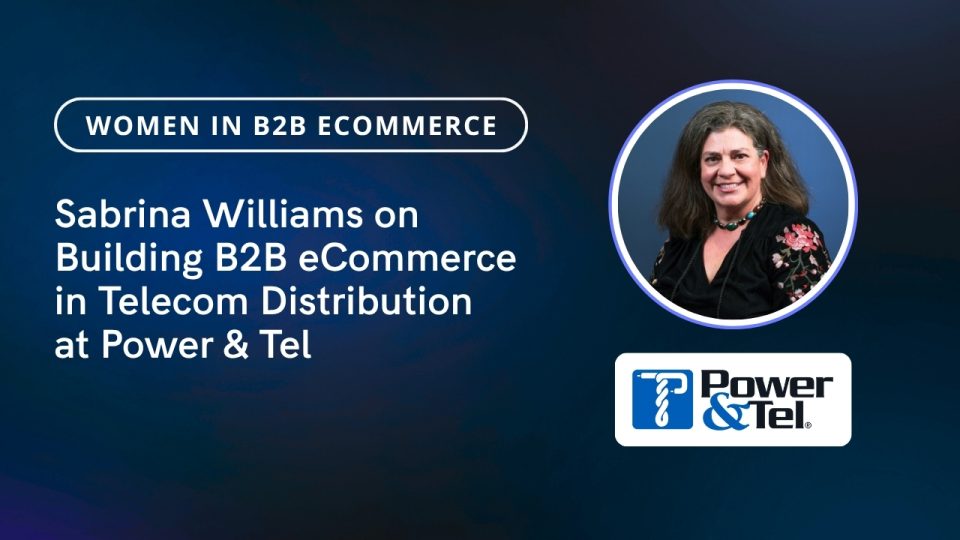
Sabrina Williams has spent more than two decades at the intersection of marketing and technology, and the niche she found there was not accidental. As an eCommerce leader at Power & Tel, the Piperton, Tennessee-based telecommunications infrastructure distributor founded in 1963, Williams manages the digital commerce program for a company that supplies the fiber cable, connectivity, and network components that make telecommunications networks run. Her conversation with B2BEA as part of the Women in B2B eCommerce series covered the arc of a career built at the edge of two disciplines, and the practical, unglamorous work of growing digital adoption in an industry that still relies heavily on the phone.
From Marketing into eCommerce: Finding the Right Niche
Williams came to eCommerce from marketing, where work in branding, customer experience, and visual communication gave her a foundation that turned out to be unexpectedly well-suited to the digital commerce world. The opportunity presented itself at a point-of-sale company that was beginning to build out its website presence. “We were back then, probably 25 years ago, just starting to get into eCommerce,” she said. “There was an opportunity to bring in the marketing skills to help rebrand generic-looking websites into more of the customer experience that the customer wanted. Logos, colors, look and feel, all that.” She joined the eCommerce team and never left.
What kept her there was a niche she identified early: the space between the visual, marketing-oriented side of the work and the technical orientation of the IT team. “I have found a nice niche right between the two groups,” she said. “Technical enough to talk to the IT people, but still in touch enough with the marketing side and the visual side, and knowing the importance of usability and colors and things like that.” That positioning, she has found, is not as common as it might seem. A commerce website has to look right and function correctly, and those two requirements reflect different ways of thinking that do not always coexist in the same person or the same team.
Selling Infrastructure Online: Digital Adoption in a B2B Telecom Market
Power & Tel distributes the components that telecommunications networks are built from, products that most buyers have historically purchased through phone calls and established account relationships. Shifting that behavior toward online ordering has required patience. “There is a slow adoption rate,” Williams said. “There is a younger group coming in that appreciates eCommerce and how they can order the same materials that they can get by calling on the phone. But there are still a lot of people who need to call on the phone and send emails. Plus we sell a lot of configurable items that aren’t suitable for online ordering.”
That pace has not discouraged her. The growth is consistent and measurable, and Williams tracks it closely. Her goal for the year was to grow Power & Tel’s eCommerce customer base by 8%, and she hit it ahead of schedule. Google remains the primary driver of inbound traffic, but the search landscape has started to shift in a direction she finds meaningful: Power & Tel has begun appearing as a cited source within Google’s AI-generated answers for certain products. “We’re seeing Power & Tel as the resource for their material,” she said, noting that the company’s visibility inside AI-powered search is something the team is paying close attention to as it builds toward broader digital authority in the Answer Engines.
Data as the Enduring Challenge
Product data is where ambitions and operational reality collide in B2B distribution, and Williams speaks about it with the candor of someone who has been managing the gap for years. “At the heart of it all, data is still the key, and trying to build our data is always important and it’s always a struggle,” she said. The questions that never fully resolve are practical ones: whether product weights and dimensions are accurate, whether specifications sourced from third parties conflict with internal records, and whether data drawn from spec sheets can be trusted before it goes live on the site.
The data enrichment teams Power & Tel works with are now using AI to improve item descriptions, making them more complete and accurate. That development reflects a broader shift across B2B distribution, where AI is beginning to take on the manual enrichment work that has historically fallen to product teams. But Williams is clear-eyed about the limits. “If it’s using bad intel, then it spits out bad intel,” she said. AI makes the process faster and more scalable; it does not replace the need to evaluate source material carefully.
An AI Use Case Worth Watching: Quote Request Triage
Of the ways Power & Tel has introduced AI into its operations, one stands out for its practical clarity. The company uses AI to filter inbound quote requests, separating legitimate leads from the volume of requests that are not. The problem it addresses is one that many B2B distribution operations face: quote requests arrive through the website in quantity, and a meaningful share of them are not from genuine customers. Some are attempts to acquire and resell high-value items on secondary platforms. Others ask for specific commodity materials, like copper-containing products, that flag immediately as outside the intent of the request form. Still others have nothing to do with the company’s business at all.
“We’ve started using AI to weed out all the junk so that the good stuff coming in is more reliable and the salespeople can focus on that,” Williams said. Introduced the previous year, the system has delivered results that are visible to the sales team: more time spent on qualified leads, less time sorting through submissions that would never convert. It is not the kind of AI application that tends to generate industry attention, but it illustrates something that tends to get underweighted in conversations about AI in B2B commerce: some of the most durable value comes from improving operational precision, not from transforming customer-facing experiences.
The Personality That Fits the Work
When asked what connects her to eCommerce as a discipline, Williams did not point to a particular credential or career milestone. She pointed to a way of thinking. “You’ve got to be able to look at 20,000 items over and over again, looking for the gaps,” she said. “You’ve got to have strong attention to detail, obviously. But you have to like to dig into research.” The patience to work through large catalogs methodically, and the curiosity to find the right image or the correct specification for an item that no one finds exciting, are traits she treats as genuine requirements for the work.
That attention to detail coexists with an ability to locate the parts of the work that feel rewarding, which for Williams are the moments where all of the operational effort becomes visible in outcomes. Managing product data, establishing weights and dimensions, and ensuring specifications are accurate are not the most visible end of digital commerce. “Balancing the boring with the fun stuff is how I do it,” she said. “As long as it’s not all boring, it’s fun.” The satisfaction comes from watching a focused product campaign drive measurable sales, from seeing email reach the right customer for the right product, from the confirmation that the system is working as designed.
Women in B2B eCommerce: Role Models, a Women-Owned Company, and What Visibility Looks Like
Williams works for a women-owned company and mentions it with evident appreciation. “Power & Tel is a women-owned company. I appreciate that,” she said. “I have been lucky to have had a lot of good role models over the years that are strong, successful women.” Access to female leadership, she believes, has shaped her professional experience and she credits both the environment at Power & Tel and the leaders she encountered earlier in her career with creating a context where gender was not an obstacle.
Sabrina Williams was interviewed as part of B2BEA’s Women in B2B eCommerce series, a program dedicated to profiling practitioners, operators, and leaders shaping the field. To connect with others in the network, join the Women in B2B eCommerce LinkedIn group. Upcoming Women in B2B eCommerce events will take place alongside major B2BEA gatherings in the United States, the United Kingdom, and Australia in 2026.
Related News & Insights
 Podcast
The founder and CEO of Luminos Labs has spent 16 years watching digital commerce projects stall…
 Podcast
Every January, a handful of reports try to tell manufacturers and distributors where B2B eCommerce is…
 Insights & advice
Teresa Herrmann manages digital commerce at Bailey International, a Knoxville-based manufacturer and distributor of hydraulic cylinders,...
 Insights & advice
For manufacturers and distributors managing large, complex product catalogs, the gap between the data that exists…
 Insights & advice
In B2B eCommerce, digital transformation rarely follows a straight line. Manufacturers and distributors face a layered…
 Insights & advice
Article Three of Four — The B2B Ecommerce Association White Paper Series on PIM Innovation Most…