

 Podcast
Adrienne Hartman on Building Sales and Marketing Alignment That Grows B2B eCommerce

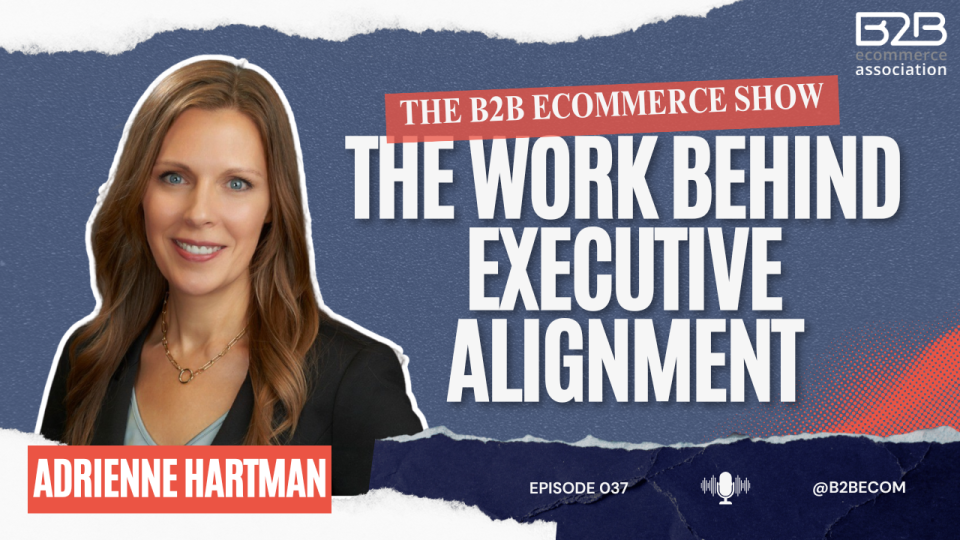
Adrienne Hartman has spent 26 years turning technical instinct into business judgment, and 19 of those years have been at J. J. Keller & Associates, where she now serves as Executive Vice President of Marketing. She joined Justin King on The B2B eCommerce Show to talk about a career that started with COBOL code and now oversees a 175 person marketing organization, including the e-commerce team, forecasting, marketing operations, and e-procurement.
The conversation covers three things that matter to any manufacturer or distributor building a digital commerce strategy: how to grow from a hands-on operator into a strategic leader, why sales and e-commerce do not have to compete for credit, and what real executive alignment looks like once the initial excitement of a new initiative wears off.
From COBOL Developer to EVP of Marketing
Hartman started her career as a COBOL developer, first at a bank data processor and then at Lands’ End, where she helped the IT department get through Y2K. That technical background became her entry point into e-commerce. Lands’ End’s new dot-com team was looking for people who understood technology and could also communicate with the business, and Hartman made the move from IT to the internet management team right as the company’s B2B site and international sites were taking shape.
She stayed at Lands’ End for four years before a recruiter from J. J. Keller called. The team she joined was six people. Today, her organization is 175. That growth mirrors a broader shift in B2B e-commerce, where teams have moved from tactical order-taking functions into strategic operations that touch forecasting, customer data, and go-to-market planning across manufacturing and distribution.
“I truly believe while my technology foundation was really helpful, I’m a better business person than I was a developer.”
Hartman
What stands out in Hartman’s path is how deliberate J. J. Keller was about preparing her for the EVP role. The company gave her new departments to run every few years, from customer insights to a special government sales project to the inbound sales team, each one stretching her scope before the top job opened. When it did, she still had to interview and compete against outside candidates. The company also arranged nearly a year of overlap with her predecessor before the transition, a level of succession planning that Hartman herself calls rare, even among privately held companies that tend to plan further ahead than public ones.
Why J. J. Keller Does Not Care How Customers Place an Order
J. J. Keller manufactures and distributes products and services that help companies stay compliant with regulations from the Department of Transportation, OSHA, and the Department of Labor. Its catalog spans physical products such as signage and safety equipment, cloud based compliance software, and managed services for functions like driver qualification.
Because the company sells through both a direct sales team and digital channels, Hartman has built her organization around a simple operating principle: it does not matter whether a customer calls an inbound rep or places an order online, as long as they order from J. J. Keller. That philosophy runs counter to how many manufacturers structure digital commerce, where e-commerce and sales compete for the same revenue and the same credit.
“I don’t view them as being mutually exclusive or one being better than the other.”
Hartman
That approach extends into how J. J. Keller handles e-procurement, the practice of businesses purchasing through automated, system to system integrations such as Ariba, Coupa, punch-out catalogs, or EDI rather than through a sales call or a manual order form. When a customer wants to integrate, Hartman’s team handles the technical setup directly so the sales rep does not need to understand the underlying protocol. B2BEA’s coverage of e-procurement adoption points to similar findings across the industry: buyers increasingly expect self-service purchasing options, even in categories that have traditionally relied on relationship-based selling.
Buyer behavior backs up that shift. McKinsey’s 2024 B2B Pulse Survey found that a majority of buyers likely to switch suppliers cited poor digital customer experience as the reason, and that buyers increasingly expect a cohesive, orchestrated experience regardless of which channel they use.
The Case for Shared Credit Between Sales and E-Commerce
One of the more unusual policies Hartman described is how J. J. Keller assigns sales credit. If a customer places an order online or through a self-service e-procurement system, the assigned sales rep still gets credit for that order, even if the rep never touched it.
“That rep is getting credit for that order because they’ve been working on that relationship.”
Hartman
The logic is straightforward. If reps were penalized for a customer choosing to self-serve, they would have every incentive to discourage digital adoption, which would work against the company’s broader growth goals. Instead, Hartman’s team actively promotes e-procurement to the sales organization as a way to help reps close more business without extra manual work. That trust has paid off in adoption numbers that, in her words, the team now struggles to roll out fast enough.
This is the kind of structural decision that determines whether a digital commerce investment succeeds or stalls. B2BEA has written about why B2B eCommerce projects fail, and misaligned incentives between sales and digital teams show up as a recurring theme. Justin King made a related point during the conversation about what happens when that alignment exists.
“If sales is behind what you’re doing, if sales is part of the adoption, that’s where you get the most adoption and evangelism, through the people that are talking to customers every day.”
King
Composable commerce, the practice of assembling best of breed platform components through APIs rather than relying on a single monolithic system, has made this kind of flexible, incentive-aligned setup easier to build. B2BEA’s reporting on composable commerce notes that this architecture gives manufacturers and distributors more room to support multiple ordering paths without forcing every customer through the same experience.
Building Executive Alignment That Survives Org Change
Hartman’s marketing organization supports three business units, each with its own leader, plus the head of sales. She described her closest working relationship as the one with the sales leader, whom she talks to more than once a day. That daily habit, not a single kickoff meeting or shared dashboard, is what she credits for keeping the two functions moving in the same direction.
“It’s something you have to continually give care to; it’s like a plant, you can’t just put it in the ground and forget about it.”
Hartman
She also warned against a common failure mode: leaders optimizing for their own department’s results instead of the company’s overall number. In her experience, that kind of self-interested decision making erodes trust between sales and marketing faster than almost anything else, even when each individual decision seems defensible on its own.
Formalizing that alignment matters too. Salesforce’s guide to sales and marketing alignment recommends structured agreements between the two teams, including clear definitions of what counts as a qualified opportunity and set timeframes for follow-up, so that alignment does not depend entirely on two people getting along.
Events as a Growth Engine, Not a Legacy Tactic
J. J. Keller runs a few hundred events a year, mostly webinars but also dozens of in-person sessions built around regulatory topics like DOT and OSHA compliance. Internal regulatory experts, the same people who write the compliance content the company sells, speak directly to attendees, which Hartman says makes the events genuinely educational rather than a sales pitch with a different name.
The events double as lead generation for the sales team, but Hartman was clear that the value only holds if the event delivers on what it promised. She pointed to poorly scoped webinars, ones that turn into a product pitch instead of the education attendees signed up for, as the fastest way to lose an audience’s trust.
Digital Commerce 360’s reporting on B2B sales channels found that e-commerce has become the top revenue channel for many B2B sellers, but events, in-person and digital, remain one of the few formats that let buyers connect directly with the people behind the product, which is a big part of why J. J. Keller has kept investing in them even as digital ordering has grown. That same customer adoption challenge, getting buyers comfortable enough with a channel to stick with it, is something B2BEA’s coverage of customer adoption strategies for manufacturers and distributors touches on as well.
About Adrienne Hartman
Adrienne Hartman is Executive Vice President of Marketing at J. J. Keller & Associates, where she leads digital commerce, forecasting, marketing operations, marketplaces, e-procurement, sales academy, and inbound sales. She serves on the boards of several Wisconsin nonprofits, including Women in Technology Wisconsin, which she helped launch. Connect with her on LinkedIn.
About the Host
Justin King is a founder of the B2B eCommerce Association, Chief AI Officer, and host of The B2B eCommerce Show, where he interviews practitioners and leaders building digital commerce strategies inside manufacturing and distribution companies.

Related News & Insights
 Podcast
The founder and CEO of Luminos Labs has spent 16 years watching digital commerce projects stall…
 Insights & advice
Teresa Herrmann manages digital commerce at Bailey International, a Knoxville-based manufacturer and distributor of hydraulic cylinders,...
 Insights & advice
The next phase of B2B eCommerce will be built on better product data. That was the…
 Insights & advice
In B2B eCommerce, digital transformation rarely follows a straight line. Manufacturers and distributors face a layered…
 Insights & advice
Article Three of Four — The B2B Ecommerce Association White Paper Series on PIM Innovation Most…
 Insights & advice
Tonia Coletta spent fifteen years in the beer industry before she ever thought seriously about millwork….