

 Podcast
Novatize CEO François-Jérôme Gosselin on Composable Commerce and the Future of B2B Product Data

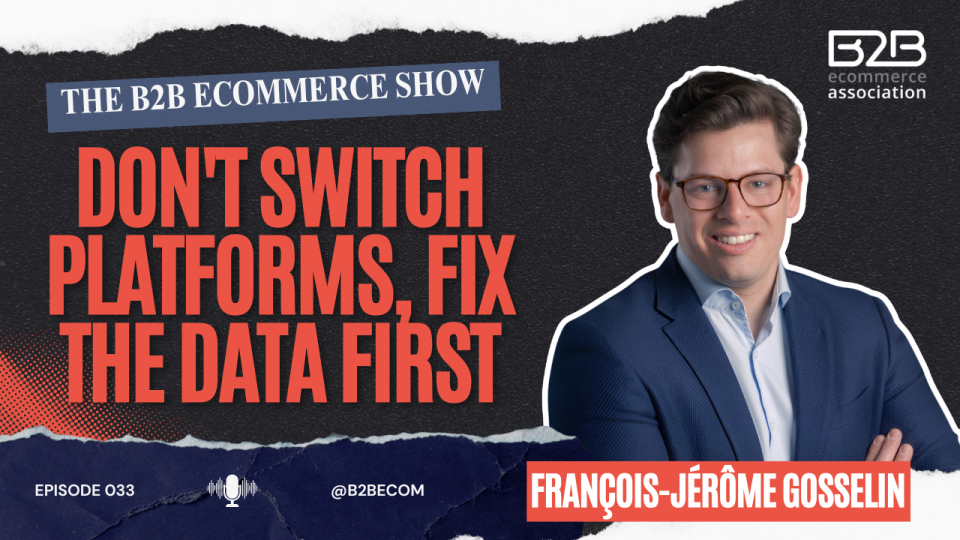
Every January, a handful of reports try to tell manufacturers and distributors where B2B eCommerce is headed. Most of them repeat the same predictions. The 2026 State of B2B eCommerce report, produced by Novatize in partnership with WBR and Shopify, is different because it comes from someone who builds these systems for a living. François-Jérôme Gosselin, co-founder and CEO of Novatize, joined B2BEA founder Justin King on The B2B eCommerce Show to walk through what the data actually says, and what it means for any manufacturer or distributor trying to figure out where to invest next.
Novatize is a digital commerce consultancy that helps manufacturers, distributors, and retailers build eCommerce systems that can scale, and François-Jérôme has spent more than a decade helping businesses separate genuine digital transformation opportunities from hype. That perspective shaped a conversation that moved from artificial intelligence spending to platform ownership to a question executives have been asking for fifteen years: who should actually run eCommerce inside a company.
AI Spending Is Rising, But It Started With the Boring Work
The report found that seventy percent of businesses plan to increase their AI spending this year. François-Jérôme said the survey data, collected in April, captured a shift that was already underway toward product and data enrichment, driven by the fact that AI tools have made it far cheaper to clean up and structure catalog information than it used to be. A PIM, short for product information management system, is the software that stores and organizes product data before it reaches a website or a distributor’s catalog, and importing catalogs into one of these systems used to require significant manual effort. That effort has dropped substantially now that AI can do much of the mapping and cleanup work.
Custom Stacks Are Still Common, But Shopify Is Gaining Ground
One number surprised François-Jérôme more than any other. Thirty-one percent of B2B companies still run on fully custom eCommerce platforms, while Shopify has become the second most common platform among companies earning between five hundred million and a billion dollars in revenue, a segment traditionally dominated by complex, custom-built systems tied directly into a company’s ERP.
“A few years back, I would never guess that Shopify would be like number two within these companies that are ranging from 500 million in revenues to a billion. For me, it’s really nice to see this, but it’s also very surprising because usually it’s very complex systems with custom pricing rules, sometimes that are live fetched from the ERP with custom logistics.”
— François-Jérôme Gosselin
Justin connected the shift to how much the eCommerce landscape has changed. An ERP, or enterprise resource planning system, is the software that runs a company’s core operations, including inventory, finance, and order processing. Ten years ago, only a handful of eCommerce platforms existed and even fewer could integrate with an ERP at all, which is part of why so many companies built custom stacks in the first place. François-Jérôme added that switching platforms used to feel like abandoning a capital investment a company had spent years building, while newer platforms are increasingly viewed as a growth tool rather than an internal cost.
Composable Commerce Is Back, This Time Built for AI
Composable commerce refers to building an eCommerce system out of separate, specialized pieces connected through APIs rather than relying on one all-in-one platform. An API, or application programming interface, is simply a defined way for two pieces of software to talk to each other. Half of the businesses surveyed said they are considering a composable stack in the next twelve months, and François-Jérôme admitted his own thinking on the approach has shifted. A year ago, he said he would have leaned toward an all-in-one platform, since so many companies tried composable systems in the past and struggled with the cost of maintaining them. Falling AI-driven development costs have changed that calculation.
Justin tied the trend directly to how AI systems interact with a business’s software, noting that APIs typically come with documentation, and an AI tool pointed at that documentation can understand everything the underlying software is capable of. François-Jérôme’s advice for any manufacturer curious about this shift was practical: try connecting the eCommerce platform to one other in-house system, such as an ERP or CRM, as a small test before committing to a larger rebuild.
Product Data Enrichment Is Moving to the Front of the Line
François-Jérôme has been talking about product data for most of his career, and he was direct about why it has suddenly become a priority again.
“It’s a pain. It’s always been a pain. So we’ve been talking about this for the last ten years, and whether it’s for SEO purposes, whether it’s for customer experience, whether it’s for now LLM discoverability, whatever it’s for, I mean, it’s always been a key component. It’s just that now it’s become easier to integrate this process.”
— François-Jérôme Gosselin
His caution for companies chasing this trend was that product data enrichment cannot be treated as a single project with a start and end date. Too many companies run it once as a one-time effort, which is exactly where it tends to fail. It needs to be an ongoing process, built into a regular workflow rather than handled through a single prompt or a one-time cleanup, a challenge other B2B practitioners have written about when it comes to catalog infrastructure at scale.
Digital Revenue Is Real, But Customer Adoption Is the Metric That Matters
The report found that most B2B companies now generate between twenty five and fifty percent of total revenue through digital channels, up from ten to twenty percent a few years ago, and buyers are increasingly comfortable placing orders of fifty thousand dollars or more online. Justin pushed back gently on how attainable that sounds for companies still building their digital channel from scratch, and François-Jérôme pointed to execution, not ambition, as the real dividing line. The true test of a platform’s success, he said, is whether a company can convince its existing customers to adopt it, typically aiming for 80 percent adoption within six to twelve months of launch.
François-Jérôme said the companies that struggle are the ones that treat a replatforming project as a fixed budget, fixed scope, one-time effort, then move the people who understood it back to other roles once it wraps. Successful companies do the opposite: they invest continuously, often starting smaller than expected, and dedicate ongoing resources to the new revenue stream rather than treating it as finished after launch. François-Jérôme has written separately about this exact pattern, arguing that executive alignment and customer adoption, not platform choice, are what actually separate successful projects from stalled ones. Justin summarized the distinction simply: product content is not a project, search is not a project, and agentic commerce likely will not be a project either. Each is a program, something a company works on continuously rather than checks off a list.
Who Should Own eCommerce? The Answer Is Shifting
The report found that forty two percent of companies place eCommerce ownership inside marketing, thirty three percent inside sales, and only twelve percent inside IT. François-Jérôme said the right answer depends on where a company is in its digital journey. A company still migrating complex tech stacks may benefit from an IT director owning that first phase, but in the long run, ownership tends to land with whichever team is closest to customer experience, adoption, and lifetime value, which is usually marketing, a pattern reflected in broader research on why B2B eCommerce efforts stall when no one owns the channel clearly.
Justin offered a related principle for larger, more established companies: whoever owns the customer journey inside a company should own eCommerce too, since that team understands the customer best.
“The most common place that’s owned is in customer service or customer success, and that’s really significantly close to the customer. If you’re a four billion dollar distributor that has all of your customers as customers for the most part, what you’re trying to do is get larger wallet share from those customers.”
— Justin King
Four Things B2B Buyers Actually Want
François-Jérôme outlined four buyer expectations the report identified, and Justin noted how closely they mirror what sales leaders already say about their own reps.
- Self-service. Buyers want to place orders, follow shipments, and manage invoices directly on the platform without picking up the phone.
- Personalization. This includes pre-negotiated pricing and catalogs specific to each customer, along with newer AI-driven features that recognize a buyer’s purchasing patterns and pre-build likely orders.
- Real-time visibility. Accurate inventory and order status at checkout, not a surprise two-week delay after the order is placed.
- Automation. Reordering, approvals, and invoice flows that move without a person in the loop once the underlying process is trusted.
Both agreed the list boils down to one idea: buyers do not want to talk to a company for basic tasks they can handle themselves, and salespeople do not want to spend their time on service requests instead of building relationships and closing deals.
Where Manufacturers and Distributors Should Start
Asked directly where a company should begin, François-Jérôme returned to the same theme that ran through the entire conversation.
“I think that product data enrichment or just having it set up is the first project you should do. You should do this on its own. You should focus energy on this before doing any other commerce project.”
— François-Jérôme Gosselin
He extended that logic to AI adoption more broadly, encouraging companies to start with content enrichment, then move on to proving out features that seem more complicated than they actually are. Justin added a companion argument about labor economics, noting that a typical five hundred million dollar distributor spends forty to sixty million dollars annually on labor, much of which goes toward routine digital tasks rather than the judgment and relationship work employees are best suited for. Closing the gap between what buyers expect and what sellers currently deliver, a gap several recent industry reports have also flagged, starts with getting the foundational data right before layering on anything more ambitious.
François-Jérôme’s closing advice was simple: talk to the buyers who will actually use the platform before building around assumptions, since it is often easier to meet their needs than a company expects. For manufacturers and distributors trying to prioritize a long list of AI and eCommerce investments, that may be the most useful filter in the entire report. Readers interested in how these shifts compare across platforms can also review Salesforce’s own B2B commerce research.
About the Guest
François-Jérôme Gosselin is co-founder and CEO of Novatize, a digital commerce consultancy that helps manufacturers, distributors, and retailers build scalable eCommerce ecosystems. Since co-founding the company in 2014, he has helped organizations navigate digital transformation by combining commerce strategy, technology, and operational execution to drive measurable business outcomes. His work spans commerce platform strategy, customer experience, AI adoption, product information management, and digital growth initiatives. Connect with François-Jérôme on LinkedIn.
About the Host
Justin King is Global Managing Director of the B2B eCommerce Association, Chief AI Officer, and host of The B2B eCommerce Show. He has been writing and speaking about B2B eCommerce since 2007.

Related News & Insights
 Podcast
Adrienne Hartman has spent 26 years turning technical instinct into business judgment, and 19 of those…
 Podcast
TreviPay’s Piers Gorman on the expectation gap between buyers and sellers, the fraud landscape reshaping credit…

 Insights & advice
A few months ago, I was reading a set of proposed AI agent use cases from…
 Insights & advice
Article Four of Four — The B2B Ecommerce Association White Paper Series on PIM Innovation The…
 Insights & advice
Most B2B manufacturers and distributors that have struggled through a product information management (PIM) implementation will…
 Insights & advice
Article Three of Four — The B2B Ecommerce Association White Paper Series on PIM Innovation Most…