

 Podcast
Execution Over Activity: How Radu Munteanu Is Rethinking B2B eCommerce for Distributors

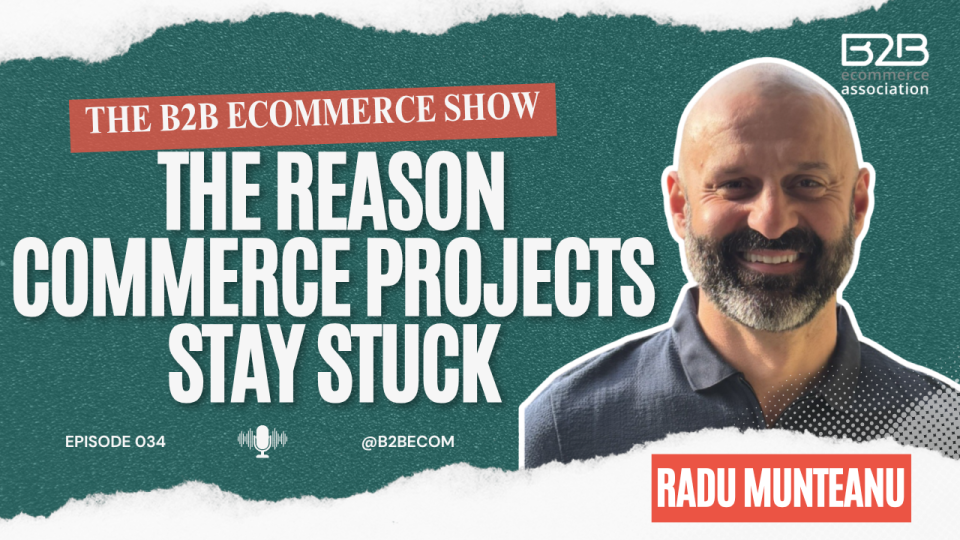
The founder and CEO of Luminos Labs has spent 16 years watching digital commerce projects stall under the weight of unnecessary process, misaligned incentives, and too many people asking questions that delay rather than advance the work. His diagnosis for distributors and manufacturers is direct: the industry keeps talking about the same problems and calling it progress.
Radu Munteanu has spent most of his career in the unglamorous part of B2B eCommerce, the technical infrastructure underneath the platform, where ERP integrations, pricing logic, and supply chain data either work or they do not. As founder and CEO of Luminos Labs, a systems integrator specializing in complex distributor environments, he has seen enough stalled projects, burned budgets, and missed launches to have developed a clear theory of why they happen, and what to do instead.
He sat down with Justin King, founder of the B2B eCommerce Association and host of the B2B eCommerce Show, for a conversation that covered execution failures, broken agency incentives, AI transparency, and what it actually means to be a good partner to a mid-market distributor in 2026.
The Weight of Commerce Execution
King opened the conversation with a phrase that many practitioners recognize immediately: commerce execution gets heavier over time. He asked Munteanu what leaders actually experience when that happens.
“From the outside, it feels safe and well managed and under control because you have all these roles on your project and you have a lot of activity and many deliverables. But at the same time, it feels heavier than it should be. Budget is being used very quickly, time goes by faster than you would have imagined, and you don’t see the results.”
Radu Munteanu, Founder & CEO, Luminos Labs
King offered a phrase that Munteanu confirmed immediately: teams mistake activity for progress. The focus shifts from outcomes to effort, from results to the appearance of results. Meetings multiply. Deliverables accumulate. The engineers who are actually building the product receive requirements filtered through multiple layers of people who are, as Munteanu put it, primarily managing perception.
“Many people focus on perception and managing perception rather than being focused on the outcomes. It feels like I’m doing a lot of work, which is managing perception. Instead of actually thinking about what is truly important and what can I not do instead.”
Radu Munteanu
For manufacturers and distributors managing live eCommerce operations alongside complex ERP environments, this dynamic has real costs. Digital transformation projects in B2B environments have long been known for scope creep and overruns, and the structure of how implementation work is sold and staffed plays a direct role in that.
The Incentive Problem Nobody Talks About
The most candid part of the conversation came when Munteanu named a structural problem that rarely surfaces in industry panels: the billing model that governs most systems integrators and digital agencies rewards activity, not outcomes.
“Companies like us, system integrators or digital agencies, we make money by billing for the work we do. So there is an incentive to have multiple roles on the project, multiple activities, deliverables, so you can bill more. And not many people talk about this, but it’s real. We’ve been part of it too.”
Radu Munteanu
King acknowledged the tension directly: project managers are rewarded based on how much they bill, customers have been conditioned to expect layered proposals, and nobody is pushing back on the model. He pressed Munteanu on what to do about it, from both sides of the table.
From the integrator’s side, Munteanu’s answer centered on long-term thinking. A client who overspends and sees poor return on investment will eventually leave. Keeping teams lean, reducing unnecessary roles, and focusing on what actually moves business goals forward is, he argued, a better business model even if it means smaller engagements in the short term.
For distributors and manufacturers on the receiving end, he recommended a straightforward practice: demand transparency and ask why, consistently.
“Clients have to keep their partners accountable to focus on desired outcomes rather than just effort. Why are we doing all of the work that we’re doing? And then looking back in the last week, last month, the work we’ve done, to what outcome, what did it lead to?”
Radu Munteanu
This kind of accountability is not standard practice. According to McKinsey’s 2024 B2B Pulse Survey, B2B organizations are under growing pressure to modernize their digital infrastructure while managing tighter budgets. That pressure makes it more important, not less, to understand what partner engagements are actually producing. The best integrators in this space, as the B2B eCommerce Association has outlined in its guide to selecting a B2B eCommerce agency, are the ones who help clients simplify complexity and build scalable operating models, not the ones who create elaborate processes to justify their contracts.
Complexity Is Not the Problem. Lack of Clarity Is.
Munteanu made a distinction that King found useful enough to push on: complexity in B2B environments is real and should not be dismissed, but complexity is not what causes projects to fail. Lack of clarity is.
Distributors deal with multiple ERPs, pricing models, channel conflict, and supply chain dependencies. That is genuinely difficult. But the same problems that derail projects in simple environments also derail them in complex ones: too many roles with overlapping responsibilities, too many meetings with unclear purposes, and too little time spent asking why a given activity is being done at all.
“When you have all these roles, project manager, business analyst, solution architect, UX researcher, information architect, visual designer, everyone is involved and everyone has an opinion and there’s so much overlap. By the time it gets to engineers who actually do the work, there is a lot of confusion.”
Radu Munteanu
His definition of clarity is practical: everyone on a project should be able to say what is being worked on right now, what has been completed and to what purpose, and what is coming next. Not as a narrative from a project manager, but as visible, real-time information that does not require interpretation.
For leaders who recognize this pattern in their own organizations, Munteanu’s advice is to start with two questions: Why do we have all of these roles on this project, and why are we performing all of these activities? The answers, he said, should connect every task to a business outcome, not to a deliverable or a slide.
Outcome-Based Billing and Its Limits
King introduced an analogy that Munteanu engaged with carefully. A city in King’s region had a bridge washed out and structured the rebuilding contract around outcome-based incentives, paying more for early delivery and less for delays. The bridge was built ahead of schedule. Could that model work in B2B eCommerce?
Munteanu agreed that aligning incentives matters, but identified an important difference: bridge construction has a clear endpoint, and the contractor does the work independently. A replatforming project is a partnership. The distributor or manufacturer has to be part of the team, not simply hand the work over the fence and wait for a delivery.
He also drew a useful distinction between the build phase of a project and what comes after it. During a replatform, the outcome is relatively clear: move from one state to another by a defined date, fix known problems, improve the experience. After launch, the work becomes continuous, and the outcomes are harder to define. That is where scope tends to grow and accountability tends to fade.
King noted that post-launch is often when the most bloat enters an engagement, as account managers who expand project scope are rewarded for that expansion. Munteanu agreed: the incentive to grow an engagement is exactly when the client is most invested and least likely to push back.
AI, Efficiency, and What Transparency Actually Requires
King raised a question that sits at the edge of what most agencies will discuss openly: AI tools have dramatically compressed the time it takes to complete technical work. If a developer can accomplish in two hours what used to take a week, but the billing model still rewards hours, what happens to the client?
Munteanu’s answer was that Luminos Labs reports AI usage to clients directly, as part of their weekly project updates.
“We send weekly reports to our clients and part of those reports, besides saying what we’ve done, how we progress against budget and the scope and the timeline, we also have a report on the AI usage. How many lines were generated with AI? How many were written manually? Per team member.”
Radu Munteanu
King’s response was immediate: “That’s amazing.” It is also unusual. Most agencies do not share this kind of data, because the efficiency gains from AI tools would, under a traditional billing model, reduce revenue. Luminos Labs has made the opposite bet: that clients who see those gains reflected in their actual costs will stay longer and refer more. In at least one case, Munteanu said, the ongoing team for a mature client has been reduced to a single engineer. The client has not left.
This approach reflects a broader shift in how AI is changing B2B operations. As the B2B eCommerce Association has noted in its analysis of agentic commerce, the coming generation of B2B buyers and operators will expect digital systems that can respond and execute, not just display information. The infrastructure for that is being built now, and the integrators who build it honestly, with transparency about what AI is doing and what humans are accountable for, are the ones likely to earn the longest-term relationships.
Execution, Not Product Data, Is the Root Problem
King shifted the conversation toward a topic that appears at nearly every B2B eCommerce conference: product data. Munteanu’s perspective was pointed.
Product data quality is not a new problem. It has been discussed through the lens of personalization, then through the lens of search, and now through the lens of AI. The same conversations that happened two decades ago are happening again with a new frame. That consistency, he argued, is itself the evidence of a deeper problem.
“Not many people talk about execution as their root problem. And I really believe everyone, the difference between companies is execution, because every company knows what has to be done. But the companies who succeed are the ones who actually execute.”
Radu Munteanu
For manufacturers and distributors, this argument has practical weight. Gartner has long tracked the high failure rates of large-scale digital transformation initiatives, and B2B eCommerce projects are not exempt. The problem is rarely the platform choice or the product data taxonomy. It is the execution system: whether teams are structured to deliver outcomes, whether vendors are accountable for results, and whether the decision-making process is clear enough to keep a project moving.
Munteanu’s answer is to fix the execution system before, or alongside, fixing the product data. For Luminos Labs clients, that meant product data problems that have been discussed in the industry for decades were actually resolved, because the team stayed focused on what needed to be done rather than on what would look good in a quarterly presentation. For more on how manufacturers and distributors can evaluate their product data infrastructure and the partners who help manage it, the B2B eCommerce Association’s guide to PIM partners and the conversation with Nichole Hess on master data governance offer useful context.
What Long-Term Client Relationships Actually Look Like
Luminos Labs works primarily with larger distributors, drawn to the complexity of environments with multiple ERP systems, intricate pricing structures, and high volumes of integration work. Munteanu’s delivery center is in Romania, where his team of engineers has worked on some of the most technically demanding projects in the distributor space, including clients managing eleven separate ERP systems simultaneously.
King asked what creates the long-term tenure Luminos has built with its clients. Munteanu named four things: transparency about what the team is doing and why, an obsession with making every dollar the client spends count, the willingness to adapt when clients push back on unnecessary roles or activities, and a deliberate focus on engineering strength rather than expanding into service areas where the firm would not be genuinely excellent.
“We’re very obsessed about eliminating what’s not needed or what doesn’t lead to a best outcome. So we don’t have too many platforms we work with, but the ones that we do work with have been battle tested.”
Radu Munteanu
He credited one client in particular with shaping his thinking. A VP of eCommerce, early in their nine-year engagement with Luminos Labs, asked Munteanu directly why they were paying for a project manager who joined all calls and took notes. His answer was to remove the layer. That kind of challenge, he said, is what good clients do, and the firms that respond to it by adapting rather than defending earn the relationships that last.
King used the word “stewardship” to describe it. Treating the client’s project the way you would treat your own. Munteanu accepted the term.
What Comes Next
King closed by asking what Munteanu is genuinely excited about in the next twelve months. The answer was AI, but with nuance: not AI as a marketing frame for the same problems the industry has been discussing for years, and not AI as an autonomous agent replacing human judgment on complex technical decisions. AI as a genuine multiplier of what lean, focused, execution-oriented teams can deliver.
“It is exciting to ride that wave and use it to create more value. Use it to actually make even more from every dollar the client spends with us. And I think this industry, it’s time to stop talking about the same problems and fix them and then take it to the next level.”
Radu Munteanu
King shared that perspective. The internal application of AI, automating the routine work that has historically consumed team bandwidth, matters more to him right now than agentic commerce or AI-powered storefronts. The efficiency is real. The firms that are honest about what that efficiency means for their clients, and that structure their engagements around outcomes rather than hours, are the ones building toward something durable.
For distributors and manufacturers evaluating their current integration partners, or considering a new digital commerce initiative, this conversation is worth taking seriously. The question is not which platform to choose or which product data tool to deploy. The question is whether the partner sitting across the table is asking why enough, and whether the answer always connects to a business outcome.
Additional Resources
From B2BEA:
Why a B2B eCommerce Agency Is Critical for a Replatforming Project | B2BEA
The Agents Are Coming: What OpenAI and Stripe Told Us About the Future of B2B Commerce | B2BEA
How Do You Find the Right PIM Partner for B2B? | B2BEA
External:
Five Fundamental Truths: How B2B Winners Keep Growing (2024 B2B Pulse Survey) | McKinsey
Gartner Report: B2B eCommerce’s Future Will Be Led by AI and Digital Transformation | Digital Commerce 360
B2B eCommerce Trends 2025-2026: Strategies Transforming Digital Commerce | BigCommerce

Related News & Insights
 Podcast
Adrienne Hartman has spent 26 years turning technical instinct into business judgment, and 19 of those…
 Podcast
Every B2B manufacturer and distributor hears the same pitch when a new commerce platform comes calling:…
 Podcast
Every January, a handful of reports try to tell manufacturers and distributors where B2B eCommerce is…

Replatforming is rarely just a technology project. It is an operational transformation initiative that touches pricing…

 Insights & advice
A few months ago, I was reading a set of proposed AI agent use cases from…
 Insights & advice
Manufacturers, distributors, and complex retailers running multi-system, ERP-centric commerce environments share a common frustration: execution that…