

 Insights & advice
The Right Technology, The Wrong Customer What PIM Vendors Can Learn From Elias Howe

Article Four of Four — The B2B Ecommerce Association White Paper Series on PIM Innovation
The Right Technology, The Wrong Customer
What PIM Vendors Can Learn From Elias Howe
By Jason HeinFounder, Acumental B2B LLCB2B Ecommerce Association
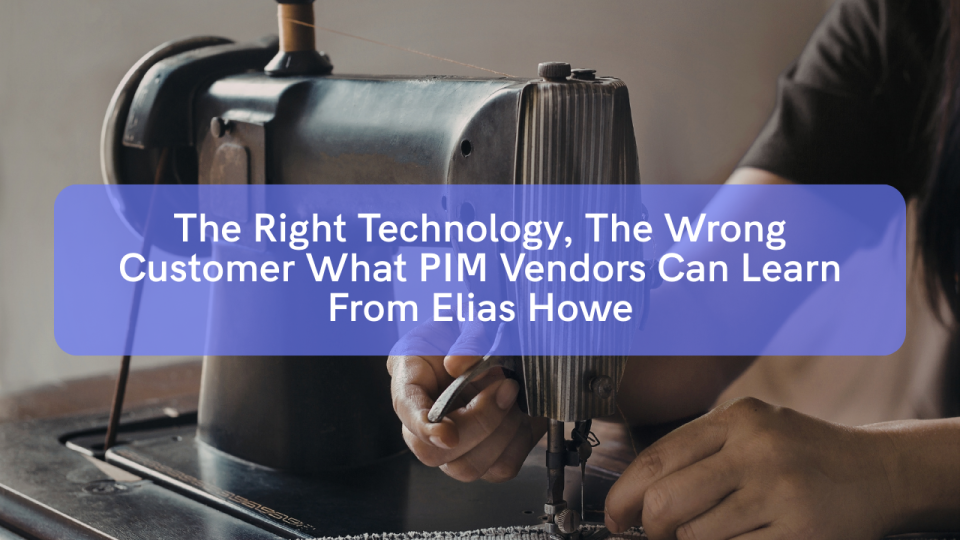
In 1845, Elias Howe patented the first practical sewing machine and immediately set about trying to sell it to the wrong people. Isaac Singer took the same technology, found the right customer, and understood precisely what that customer needed to hear. Singer’s name is on the machine. Howe is a footnote. The B2B PIM market in 2025 is full of Elias Howes.
Howe went to England first, pitching to professional tailors, the people whose entire livelihood was built around the hand-stitching work his machine could replace. They rejected him. The tailors saw the machine as a threat rather than a tool, and Howe was pitching it on their terms, in their context, as a replacement for something they had spent their careers mastering. He returned to America having sold almost nothing, deeply in debt, and forced to pawn his model and his patent papers just to afford the voyage home.
Isaac Singer took the same technology and did something Howe never thought to do: he correctly identified who the real customer was and built an entirely different pitch for them. Singer targeted the American household, specifically women who spent enormous amounts of time on domestic sewing, and sold the machine not as a threat to craft but as liberation from drudgery. He invented the installment payment plan to make it accessible to families who couldn’t afford the upfront cost. He built a sales and service network that met customers where they were.
Singer’s name is on the machine. Howe is a footnote.
Same technology. Same capability. Completely different understanding of who the customer was, what problem they were actually trying to solve, and what a credible pitch to that customer looked like. The B2B manufacturers and distributors sitting through PIM demos today aren’t the tailors. They are the home consumers, watching a pitch designed for someone else and trying to figure out where they fit.
This paper is about what it takes to be Singer.
The B2C Inheritance Problem
PIM as a category was shaped significantly by consumer commerce. The earliest and most visible use cases, apparel, cosmetics, consumer electronics, grocery, established the dominant mental model for what product data management is for and what problem it solves.
In B2C, the product content job is fundamentally a presentation problem. The goal is to make a product desirable to a consumer who already understands what the product category is. Everyone knows what a shoe does. Everyone knows what a moisturizer is for. The content job is to make this particular shoe or this particular moisturizer feel right for this particular consumer, through imagery, through social proof, through aspirational framing, through the emotional and aesthetic signals that drive purchase decisions in consumer contexts.
That framing, product content as presentation, as desirability signaling, as consumer experience optimization, carried forward into the go-to-market assumptions of PIM vendors who subsequently moved into B2B. The demo environments stayed polished and consumer-adjacent. The value propositions emphasized channel consistency and visual presentation. The success metrics centered on page conversion and digital shelf share, concepts borrowed directly from B2C ecommerce.
And the B2B buyers sitting through those demos were doing translation work the entire time. “Okay, the color attribute here would be the thread specification in my catalog. The lifestyle imagery here would be the application diagram in mine. The star rating here would be, actually, we don’t really use star ratings for hydraulic fittings. Our customers need to know whether this fitting meets the pressure rating for their specific system configuration.”
That translation work is the sound of a vendor losing a buyer’s confidence in slow motion.
In B2B, the product content job is not a presentation problem. It is a knowledge problem. The buyer is not deciding whether they want something. They are deciding whether it will work, for a specific application, under specific operating conditions, within a specific system, in compliance with specific industry standards. Getting that decision wrong has consequences that go well beyond a return shipment. It can mean a system failure, a production shutdown, a compliance violation, or a safety incident.
The content that serves that decision is not imagery and aspirational copy. It is precise technical specification, application parameters, compatibility data, compliance certifications, and the kind of deep product knowledge that allows a buyer to make a high-stakes technical decision with confidence, without calling a salesperson to verify what the website should have told them.
Howe pitched a labor-saving device to people who saw their labor as their identity. PIM vendors are pitching a presentation platform to people whose primary need is a knowledge infrastructure. The mismatch is different in detail but identical in structure.
B2BEA White Paper Series on PIM Innovation, Paper Four of Four
What Manufacturers Actually Need to Hear
The default PIM pitch to manufacturers is syndication. We will help you deliver your product data to your distributors in whatever format they require. We will manage the translation of your catalog into Grainger’s taxonomy, Motion’s attribute requirements, any trading partner’s data standard. We will make your channel relationships more efficient and your distributors more effective at representing your products.
That pitch is not wrong. Syndication is a real problem and solving it has real value. It is also not the primary problem a manufacturer has, and leading with it signals to a sophisticated manufacturer that the vendor has not fully understood their situation.
The primary problem a manufacturer has is upstream of syndication. Before they can deliver structured product content to any channel partner, they have to have structured product content to deliver. For most manufacturers, that means an excavation project of significant scope: finding product knowledge scattered across legacy ERP systems, engineering documentation, CAD files, acquisition assets, and institutional memory, and consolidating it into a structured source of truth that can actually feed a digital channel.
But there is a second manufacturer problem that sits at the very heart of what makes B2B product data different from consumer product data, and it is the one that almost no PIM vendor has built a pitch around: precision within a product line.
B2B manufacturers, particularly in industrial and technical verticals, offer products that are finely differentiated for specific applications. The difference between this hydraulic fitting and that one is not a matter of style or preference. It is a matter of pressure rating, material compatibility, thread standard, and operating temperature range, and specifying the wrong one into a system has real consequences. The manufacturer’s content job is to represent that differentiation with enough precision that a buyer can determine with confidence which specific SKU meets their requirements for their specific application, without ambiguity and without a phone call.
That is a fundamentally different content challenge than presenting a product attractively to a consumer. It requires attribute schemas deep enough to capture application-specific performance parameters. It requires the ability to express why product A is right for application X and product B is right for application Y, in structured, filterable, searchable data, not in marketing copy. It requires a platform that was designed with the understanding that in B2B, the product data is the expertise, and the expertise is what the buyer is evaluating.
What This Requires in the Sales Conversation
Stop opening with syndication. Open with the knowledge problem. Ask the manufacturer: where does your product knowledge live right now, and how much of it exists in a form that a digital channel can actually use? Let them describe the legacy ERP, the engineering archives, the retired engineer’s tribal knowledge, the acquisition assets nobody has fully integrated. Then show them how the platform addresses that, not as an implementation services conversation but as a product capability conversation. Ask them about their most technically complex product family. Ask them what differentiates the products within that family at the application level. Those two conversations, the excavation conversation and the precision conversation, are the ones that make a manufacturer feel genuinely understood. Neither appears in the standard syndication pitch.
What Distributors Actually Need to Hear
The default PIM pitch to distributors is normalization. We will help you take the heterogeneous data arriving from hundreds of suppliers and make it consistent. Same attributes, same units of measure, same taxonomy, same terminology across your entire catalog. Your customers will be able to find what they need. Your search will work. Your navigation will make sense.
That pitch is accurate. Normalization is the foundation and it is genuinely hard to achieve at scale. Getting there matters enormously. It is also where most vendor pitches stop, and where the most valuable part of the distributor opportunity begins.
The distributor problem has two layers that have to be addressed in sequence. The normalization layer is the first. The second layer is what a distributor can build on top of a normalized catalog that their competitors (who carry the same SKUs from the same suppliers and received the same source data) cannot replicate by running the same normalization process.
That second layer has two distinct components that vendors are currently not addressing in distributor sales conversations.
The first is cross-supplier solution architecture. Distributors don’t just sell products. They sell solutions, and those solutions frequently require components from multiple manufacturers assembled into a configuration that works together. A distributor who can represent compatibility and configurability across supplier lines in their catalog, who can show a buyer not just that this valve exists but that it is compatible with that actuator and that fitting from two different manufacturers, is providing a level of expertise that the manufacturer of any individual component cannot provide. That expertise lives in the relational data structure of the catalog, and it requires a PIM that can represent cross-supplier product relationships with confidence and precision.
The second is content voice at scale. Every distributor carrying the same products from the same manufacturers received the same supplier data feeds. Normalization gets everyone to the same starting line. The distributor who uses their PIM as an authorship platform, storing and governing customer-segment-aware attribute strategies, copy standards, and content frameworks that express their specific expertise for their specific customer base, builds something that competitors cannot replicate simply by cleaning up the same feed.
This is not primarily a copywriting argument. It is a structured data argument. The distributor who knows their customer base skews toward aerospace captures the specifications met attribute for fasteners and surfaces it prominently in faceted search. The safety distributor whose customers are making compliance-driven purchasing decisions ensures that every relevant certification attribute is populated completely and displayed prominently for the categories where it matters. The MRO distributor whose customers are frequently solving application problems structures their catalog around application context rather than supplier taxonomy.
Those are PIM decisions. They reflect customer knowledge that the distributor has and the manufacturer (selling to everyone) cannot apply specifically enough. And they cannot be executed consistently across a catalog of hundreds of thousands of SKUs without a platform that supports the governance, the standards enforcement, and the workflow that keeps them current as the catalog grows and evolves.
What This Requires in the Sales Conversation
Stop ending the demo at normalization. After showing how the platform handles supplier data intake and catalog consistency, ask the distributor: what do you know about your customers that your suppliers don’t know? What attributes matter to your specific customer segments that the manufacturer’s standard data feed doesn’t capture? What does a complete solution look like for a buyer in your most important vertical, and can your catalog currently help a buyer assemble that solution without calling a salesperson? Those questions position the vendor as a strategic partner in the distributor’s digital program, not just a data management platform. They open the conversation about the second layer, the one where the real competitive differentiation lives and where the platform’s long-term value compounds year over year.
The Sandbox Problem: Why Consumer Goods Demos Are Costing You Deals
There is a specific practice in PIM sales that deserves direct attention because it undermines vendor credibility in a way that is both significant and entirely avoidable.
Most PIM vendors demo their platforms using sandbox environments populated with consumer goods. Apparel. Cosmetics. Consumer electronics. Grocery. These catalogs are clean, visually rich, and easy to navigate in a demo context. They showcase the platform’s presentation capabilities effectively. They are almost completely irrelevant to the B2B manufacturer or distributor sitting in the room.
The B2B buyer watching a cosmetics catalog demo is not seeing their business. They are seeing a parallel universe with different products, different attribute structures, different customer decision contexts, and different definitions of what complete product data looks like. The mental translation work required to map what they’re seeing onto their own catalog introduces doubt, and doubt is the enemy of a deal.
Beyond the relevance problem, the consumer goods sandbox communicates something the vendor probably doesn’t intend: we haven’t thought carefully enough about your business to show you your business. For a buyer making a significant platform investment that will shape their digital program for years, that signal lands badly.
Isaac Singer didn’t demonstrate his sewing machine by showing women how tailors used it in a professional shop. He showed them what it could do in their context, for their purposes, with the kind of work they actually needed to accomplish. The demo environment was not a translation exercise. It was an immediate, visceral demonstration of relevance.
The alternative to the consumer goods sandbox is a proof of concept using the prospect’s actual product data.
A POC with real data does things the sandbox demo cannot. It shows the buyer their own products in the platform, their attribute schemas, their catalog structure, their supplier data challenges, handled by the system they’re evaluating. It eliminates the translation work and the doubt that comes with it. It surfaces real capability gaps before the contract is signed, when they can be addressed, rather than after, when they become relationship-ending problems. And it demonstrates a level of confidence in the platform’s B2B capabilities that a controlled sandbox environment cannot demonstrate by definition.
The objection vendors raise to POCs is real: they require significant pre-sales investment. Ingesting a prospect’s data, configuring a meaningful demo environment, and presenting it credibly takes time and expertise that is already stretched across a sales cycle that is longer than anyone in the vendor organization wants it to be.
But this objection deserves scrutiny. The sales cycle is long partly because buyers don’t have enough confidence to commit. They’ve been burned by implementations that didn’t deliver what the demo promised, because the demo was a consumer goods sandbox and the implementation was their industrial catalog. The POC that vendors are avoiding to protect pre-sales capacity is precisely the investment that would shorten the cycle they’re complaining about.
The Selection Effect
Vendors who insist on sandbox-only demos may be doing so because they are not confident in what happens when real B2B product data hits their system. The vendor who offers a POC proactively, who says bring us your most complex product family and your messiest supplier data set and let us show you what we can do with it, is signaling the opposite. That confidence is itself a competitive differentiator in a market where most vendors keep the environment carefully controlled.
The vendors who make POCs a standard part of their enterprise sales process for B2B accounts will close faster, lose fewer deals to no decision, and produce implementations that deliver what was promised, because the gap between the demo and the reality was closed before the contract was signed.
The Trust Gap and the Counter-Intuitive Way to Close It
B2B buyers evaluating PIM platforms today are, as a category, more skeptical than they were five years ago. The reason is straightforward: more of them have been through implementations that didn’t deliver. They bought platforms that were demoed against consumer goods sandboxes and implemented against industrial catalogs. They absorbed the pre-sales pitch about syndication and normalization and discovered mid-implementation that the platform’s B2B capabilities were shallower than the demo suggested. They spent budget on solutions that solved the wrong problem: syndication when they needed excavation, normalization when they needed precision, a presentation platform when they needed a knowledge infrastructure.
That scar tissue makes the sales process harder for everyone. It extends timelines, multiplies stakeholder reviews, generates more reference check requests, and produces more no-decision outcomes as burned buyers conclude that no vendor is meaningfully better than another.
The way to close the trust gap is not a better pitch. It is a different kind of conversation.
The most trust-building thing a PIM vendor can do in a B2B sales conversation is demonstrate that they understand the buyer’s problem more precisely than the buyer expected, and are willing to tell the truth about what their platform does and doesn’t do well.
For manufacturers, that means opening with the knowledge problem rather than the syndication capability. It means asking about the excavation challenge before showing the output layer. It means demonstrating familiarity with the organizational dynamics, IT versus business ownership, incremental resourcing, the distribution of product knowledge across departments, that determine whether a manufacturer implementation succeeds or stalls. A vendor who can speak to those dynamics from experience is one who has been inside enough manufacturer programs to know what actually happens, not just what the implementation methodology prescribes.
For distributors, that means pushing past normalization into the second layer conversation. It means asking about customer segments, application contexts, and cross-supplier solution requirements before opening the demo. It means demonstrating that the platform was designed with the understanding that B2B distribution is an expertise business, and that the content voice a distributor builds on top of normalized data is where the long-term competitive value lives.
And for both audiences, it means being willing to say something that almost no vendor says in a sales conversation: here is where our platform is strongest, here is where another platform might serve you better, and here is how to tell the difference.
That kind of honesty is rare in any enterprise software sales process. In a market as scarred by failed implementations as B2B PIM, it is extraordinary. And it is the single most reliable signal a buyer can receive that the vendor in front of them understands their business well enough to be trusted with their implementation.
Elias Howe spent years trying to convince people who didn’t need his machine that they did. Isaac Singer found the people who did need it, understood precisely why they needed it, and built an entire commercial model around serving them. Singer didn’t just sell more machines. He built an industry.
The vendor who earns genuine trust in the B2B PIM market will not just win more deals. They will win reference customers who tell the story of being treated honestly in a sales process, which, in a market driven by peer recommendations and conference conversations, compounds in value in a way that no marketing campaign can replicate.
The Vendor Who Gets There First
The B2B PIM market is at an inflection point. Buyers are more sophisticated. The questions they ask are harder. The implementations they’ve been through have taught them what to watch for and what to be skeptical of. The consumer goods sandbox demo, the syndication-first manufacturer pitch, the normalization-as-destination distributor conversation: these are increasingly recognizable as signals that the vendor hasn’t fully understood the B2B context they’re selling into.
The vendor who gets ahead of this inflection point has a specific set of things to build and a specific set of things to change.
Build a manufacturer demo environment using industrial B2B product data.
Fasteners, hydraulic components, electrical equipment, safety products: showcase depth within a product line, application-specific attribute precision, and the excavation and content discovery capabilities that address the primary manufacturer challenge. Make the POC with real customer data a standard part of the enterprise sales process, not a concession extracted through negotiation.
Build a distributor demo environment that goes past normalization.
Show cross-supplier solution architecture, customer-segment-aware attribute strategy, and the governance infrastructure that makes a content voice scalable across a catalog of hundreds of thousands of SKUs. Show what the catalog looks like not just when the data is consistent but when it is genuinely useful to a technically sophisticated B2B buyer making a high-stakes purchasing decision.
Train the sales and pre-sales team on the actual differences.
Give them the language to open the excavation conversation, the precision conversation, and the content voice conversation before they open the demo environment. A vendor whose pre-sales team can diagnose which problem a prospect has, and articulate it back to them more precisely than they articulated it themselves, has already won a significant portion of the trust battle before the platform capabilities are even on the table.
Build the organizational willingness to tell a prospect when their problem is better suited to a different solution.
That willingness is the hardest thing to develop because it runs counter to every instinct in a sales culture. It is also the thing that transforms a vendor from a platform option into a trusted advisor. Trusted advisors in enterprise B2B software don’t lose deals to competitors. They lose deals to no decision, and they win back those buyers when the no decision becomes a decision eighteen months later.
The Position Is Available
Elias Howe had the right technology and the wrong customer. Isaac Singer had the same technology, found the right customer, and understood precisely what that customer needed to hear. Singer didn’t just sell more machines. He built an industry.
The B2B PIM market is at an inflection point: buyers are more sophisticated, the questions they ask are harder, and the implementations they’ve been through have taught them what to watch for. The consumer goods sandbox demo, the syndication-first manufacturer pitch, the normalization-as-destination distributor conversation are increasingly recognizable as signals that the vendor hasn’t fully understood the B2B context they’re selling into.
The vendor who earns genuine trust will not just win more deals. They will win reference customers who tell the story of being treated honestly in a sales process, which, in a market driven by peer recommendations and conference conversations, compounds in value in a way no marketing campaign can replicate. The B2B PIM market is waiting for its Isaac Singer. The position is available. The question is which vendor claims it first.

Related News & Insights
 Podcast
The founder and CEO of Luminos Labs has spent 16 years watching digital commerce projects stall…
 Insights & advice
By Troy Sample, Vice President of Sales, and Dan Bronson, Partner, Digital Strategy and SEO, impaqX…
 Insights & advice
Hiram Bingham didn’t wander into the Peruvian Andes and stumble across Machu Picchu. He planned an…
 Insights & advice
Article One of Four — The B2B Ecommerce Association White Paper Series on PIM Innovation Manufacturers…
 Insights & advice
When Stacy Hanks joined SureWerx as Vice President of Global Digital Commerce, she brought something the…
 Insights & advice
I’ve intentionally waited a week to write this. B2B eCommerce World has lit up LinkedIn with…