

 Podcast
Graham Lubie on the AI Enablement Pyramid: What Manufacturers and Distributors Need Before They Automate

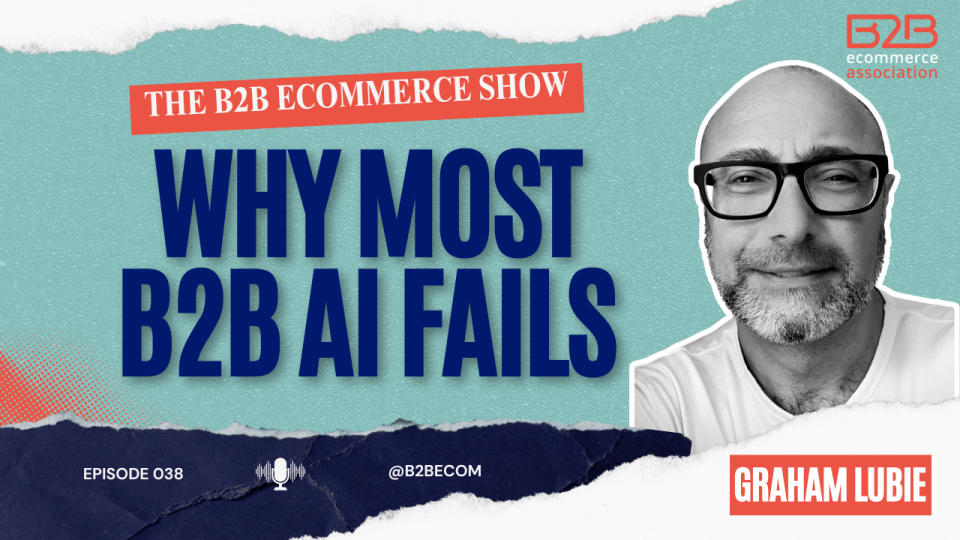
Most manufacturers and distributors already know they need to do something about artificial intelligence. Few know where to start, and fewer still know what separates a company that is genuinely building AI capability from one that is simply handing out ChatGPT logins and calling it a strategy.
Graham Lubie has spent the past several years answering that question for B2B companies directly. He leads the digital practice at Cadent Commerce, the B2B-focused arm of THE·TEAM, a global marketing and technology agency that recently rebranded to sharpen its identity around manufacturers and distributors. Graham joined Justin King on The B2B eCommerce Show to talk through what he calls the AI enablement pyramid, a framework his team built after watching client after client stall out at the same stages of AI adoption.
From Wasserman Digital to Cadent Commerce
Graham’s team was previously known as Wasserman Digital, operating under the broader Wasserman umbrella, an agency built primarily around sports and entertainment marketing. The rebrand to Cadent Commerce, about three months old at the time of the conversation, was a deliberate move to give the B2B practice its own identity.
“We felt that by having a standalone brand of Cadent Commerce, we’d be able to really build that identity in the space and highlight something that we’ve been doing for a long time, which is working with manufacturers and distributors on their eCommerce strategy.”
— Lubie
The parent company, THE·TEAM, still runs large-scale marketing programs for brands like Lenovo and Progressive Insurance and represents talent across sports and entertainment. But Cadent Commerce operates as a boutique consultancy inside that structure, focused specifically on helping B2B manufacturers and distributors go to market in digital channels. Graham’s team draws on the resources of a 4,000-person, 26-country organization while still functioning like a specialist shop for B2B eCommerce.
The Gap Between Personal AI Use and Business Transformation
Justin asked Graham where he sees the biggest disconnect between how manufacturers and distributors think about AI and what it actually takes to get value from it. Graham’s answer centered on a maturity gap that shows up in nearly every client conversation.
Most companies, he explained, are still thinking about AI as personal productivity. Give every employee a ChatGPT seat and call it done. That is a reasonable first step, but it stops well short of AI functioning as a business enabler that changes how work actually gets done. According to B2BEA’s own research on AI adoption sequencing, digitizing operations and commerce first is what makes a company ready for AI use cases at all, which lines up closely with what Graham sees in the field.
Graham also pointed to where the pressure to adopt AI usually originates. In many of his client conversations with CIOs, VPs of technology, and CEOs, the mandate comes down from the board.
“Figure out what your business’s top three objectives are, and figure out how AI can help achieve those business objectives. Because that’s your strategy, right? It’s how does AI help you meet your strategic goals, not where can I implement AI for AI’s sake.”
— Lubie, citing Michael Mangione of W. L. Gore & Associates
Justin picked up on that distinction directly, noting that AI adopted without a clear strategic purpose tends to produce bolt-on features rather than a real operating advantage.
Inside the AI Enablement Pyramid
The framework Graham’s team built has three layers, and he was careful to note that most companies today are still working through the first one.
Layer One: The Foundation
Before any AI agent can do useful work, the underlying data and systems need to be in shape. Graham described this as clean data, accessible APIs, an authentication architecture, governance, and single sign-on. Without that plumbing, AI has nothing reliable to work with.
He gave a concrete example from a client project where an AI initiative was being held back by a slow API connection into the client’s ERP system. His team had to rebuild the API for performance before the AI agent could use the data at all. It is unglamorous work, but it is the work that determines whether everything built on top of it actually functions.
Layer Two: Leverage What You Already Own
The second layer is about recognizing AI capabilities that are already rolling out inside the platforms a company uses every day. Graham pointed to purchase order automation as a clear example, where a paper order or even a photo of a handwritten note can be ingested by AI and converted directly into a transaction. That capability is already shipping across major B2B commerce platforms, and Graham’s larger point was that many companies have not stopped to ask what their existing tools can now do for them.
Catalog and product data cleanup came up as another example. B2BEA has covered this exact problem area in depth, including how structured, AI-ready product data determines whether distributors are even discoverable to AI-powered procurement tools, and how AI-driven enrichment can meaningfully improve product data accuracy and time to market.
Layer Three: Building Differentiation
The top of the pyramid is where a company builds something no off-the-shelf platform offers, because the process is unique enough to justify custom agentic workflows. Graham described a client in pharmacy benefits management, an industry with dense, multiparty data flows that historically ran through phone calls, faxes, and emails. Agentic workflows now streamline that communication in ways that were not previously practical.
Justin connected this back to how his own team has approached podcast production, describing a process that expanded from five manageable human steps to sixteen once an agent was doing the work, opening room for detail-oriented steps that were never feasible with a purely human team.
Requirements Gathering, Rebuilt
The conversation also turned to how AI has changed Cadent Commerce’s own delivery process, not just what they build for clients. Graham broke his methodology into discover, define, design, develop, deploy, and evolve, and said requirements gathering, historically the most important and most tedious phase of any project, has been reshaped the most.
Recorded meetings can now be mined directly for requirements. His team also pulls in existing SOPs, historic call center logs, website documentation, and business rules as a starting point before workshops even begin, and they have started building reusable requirement libraries by industry vertical. On one project rebuilding a legacy payments module for an open source commerce platform, Graham estimated AI cut the effort required by roughly two-thirds, though an engineer still had to manually verify every use case against the original code.
What Graham Means by “AI Slop”
That verification step matters, because Graham has watched what happens when it gets skipped. He described a marketing agency that ran an automated site scan and forwarded the results to a client without reviewing them first.
“The vast majority of the issues are not issues, and there were some references to a totally different site that showed up in the result set.”
— Lubie, describing his team’s review
Cadent Commerce responded by building what Graham called a hygiene scorecard, a standing set of AI-based scans across security, accessibility, and SEO that are reviewed by human solution architects before anything gets logged as a real issue. Once a flagged item is confirmed as a false positive, it is not raised again. This kind of human-in-the-loop governance is exactly what analysts are pointing to as the dividing line between AI pilots and AI that actually holds up in production, a distinction McKinsey’s research on agentic AI in advanced industries makes clear is where most manufacturers still have work to do.
Will AI Replace Service Providers?
Justin closed with the question every agency leader gets asked now: if clients can build everything themselves with AI tools, do service providers still have a role? Graham did not hedge.
“I don’t think service providers are going to get replaced, and the reason I don’t think that is because there is, as good as the AI models are today, and maybe they’ll be incredible in a few years, value in people that are expert in different technologies and different capabilities that can bring that expertise learned on lots of engagements to help solve problems.”
— Lubie
His view is that expertise becomes more valuable, not less, as AI lowers the cost of building things. Someone still needs to know what problem is worth solving, what the right architecture looks like, and when the AI has quietly gotten something wrong. Industry analysts covering the consulting sector are reaching a similar conclusion, expecting providers to reprice and restructure around AI-augmented delivery rather than disappear, a shift Forrester’s analysis of the AI consulting landscape frames as a repeat of past transitions like offshore labor and cloud computing.
Justin’s closing question to Graham was practical: for manufacturers and distributors who know they need to move but do not know where to begin, what is the first step? Graham’s answer brought the conversation back to the foundation of the pyramid itself. Identify your biggest operational problems first, then work backward to where AI can genuinely help, rather than starting with the technology and searching for a use case to justify it. Building the connective layer that lets AI systems actually talk to enterprise tools, an area covered in depth by recent analysis of the Model Context Protocol standard, is part of that same foundational work Graham described as unglamorous but essential.
About the Guest
Graham Lubie leads the digital group at THE·TEAM, which designs, builds, manages, and markets eCommerce solutions, custom applications, and complex digital integrations for business-to-consumer and business-to-business companies. He began his career at Accenture before moving into strategy and marketing leadership roles in technology. Connect with him on LinkedIn.
About the Host
Justin King is a renowned thought leader in the B2B eCommerce industry with over 20 years of experience. Throughout his career, he has been instrumental in helping businesses of all sizes successfully navigate the complex world of B2B digital commerce. As the author of the best-selling book “Digital Branch Secrets,” Justin offers valuable insights and strategies for companies looking to optimize their online presence and increase their revenue.

Related News & Insights
 Podcast
Every B2B manufacturer and distributor hears the same pitch when a new commerce platform comes calling:…
 Podcast
The founder and CEO of Luminos Labs has spent 16 years watching digital commerce projects stall…
 Podcast
TreviPay’s Piers Gorman on the expectation gap between buyers and sellers, the fraud landscape reshaping credit…
 Insights & advice
Most B2B eCommerce projects do not fail because organizations lack commitment or investment. They fail because…
 Insights & advice
MillerKnoll has been doing B2B eCommerce for more than twenty-five years. That tenure, spanning multiple platform generations,…
 Insights & advice
When I speak with executives at manufacturing and distribution companies about B2B eCommerce, the conversation tends…