

 Insights & advice
Digital Transformation: Beyond the Buzz

“Digital transformation” has become one of the most overused phrases in business. Used loosely enough, it can mean anything from moving off spreadsheets to rebuilding an entire operation from the ground up. In wholesale distribution specifically, it tends to get applied to one thing most often: launching an eCommerce site.
That’s where most companies stop. And it’s where most companies go wrong.
What Digital Transformation Actually Means for Distribution
For the businesses we work with (wholesale distributors and manufacturers across HVAC, electrical, building materials, and industrial supply), digital transformation is an organizational decision, not a technology one. It’s the recognition that a digital channel exists, that your customers are already using it, and that your business processes need to adapt to support it.
A new website, on its own, doesn’t do any of that. It just creates a new place for your existing problems to hide.
It’s Not About the Website
The most common misconception in wholesale distribution is that going digital means launching a site and waiting for it to work. Put the site up, and the orders will follow. When results don’t materialize, the platform gets the blame… re-platform, reset, repeat.
The site isn’t the problem. The thinking is.
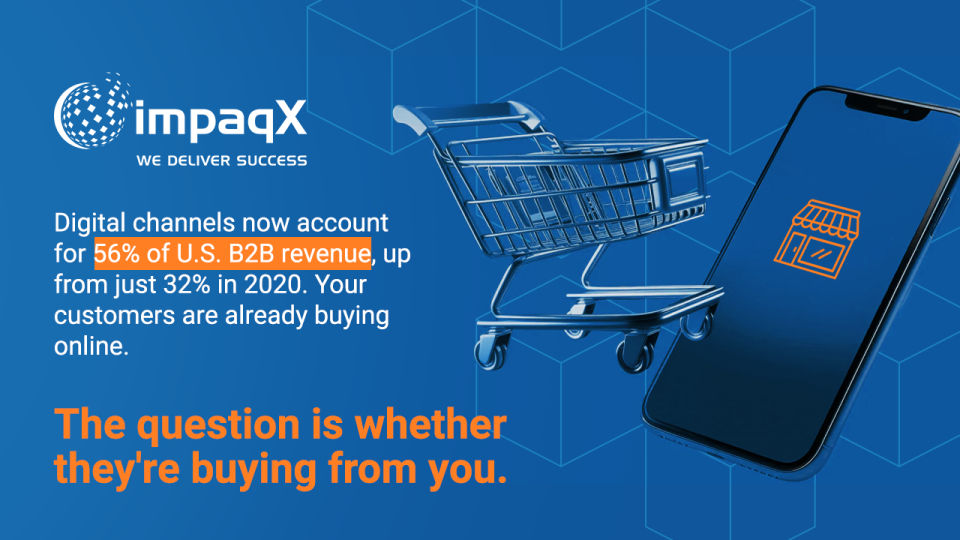
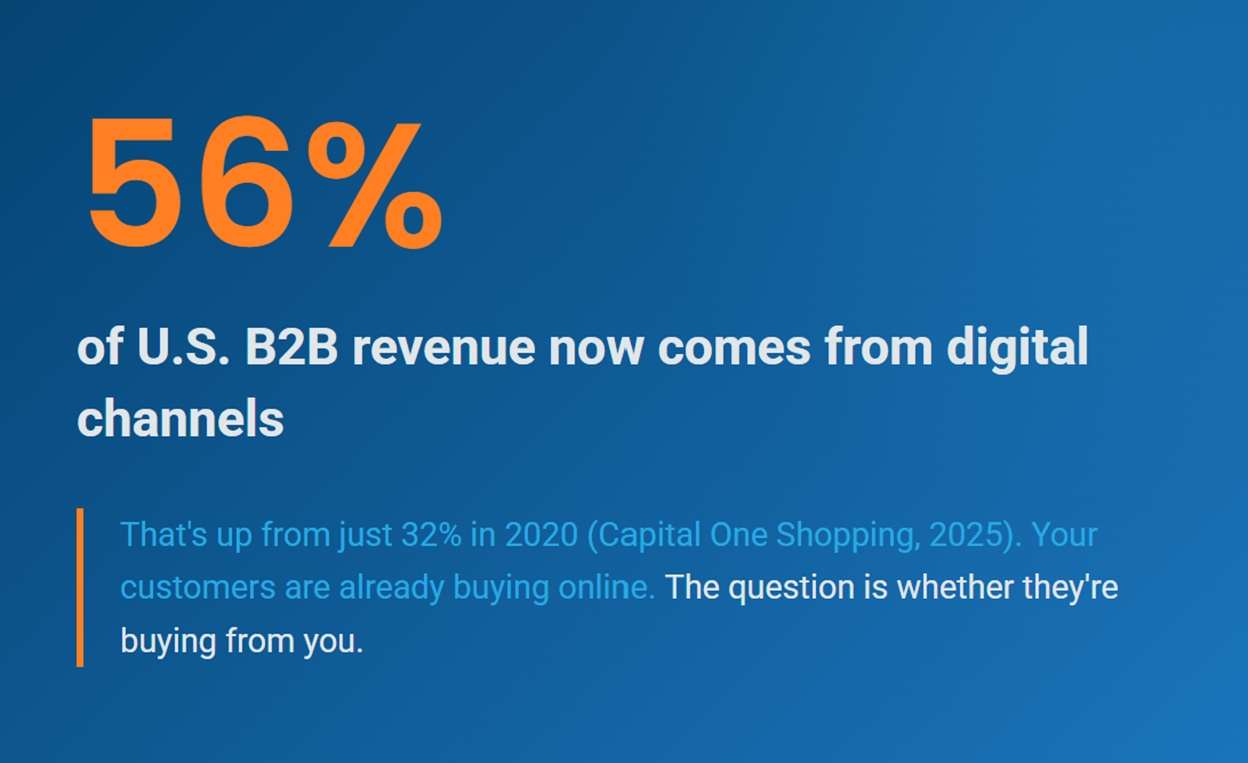
Digital channels now account for 56% of U.S. B2B revenue, up from just 32% in 2020 (Capital One Shopping, B2B eCommerce Statistics, 2025). That shift didn’t happen because companies just launched websites. It happened because their leaders treated digital as a true business channel and committed to making it work. There’s a significant difference between those two things, and most businesses underestimate it.
The distributors driving real growth treated their digital channel as a business initiative from day one. They asked the hard questions upfront, aligned their organization around clear objectives, and committed to the operational changes required to make the channel work. Essentially, they approached their ecommerce experience with the same intentionality as they’d apply to any major revenue-generating investment.
The “Digital Branch” Problem
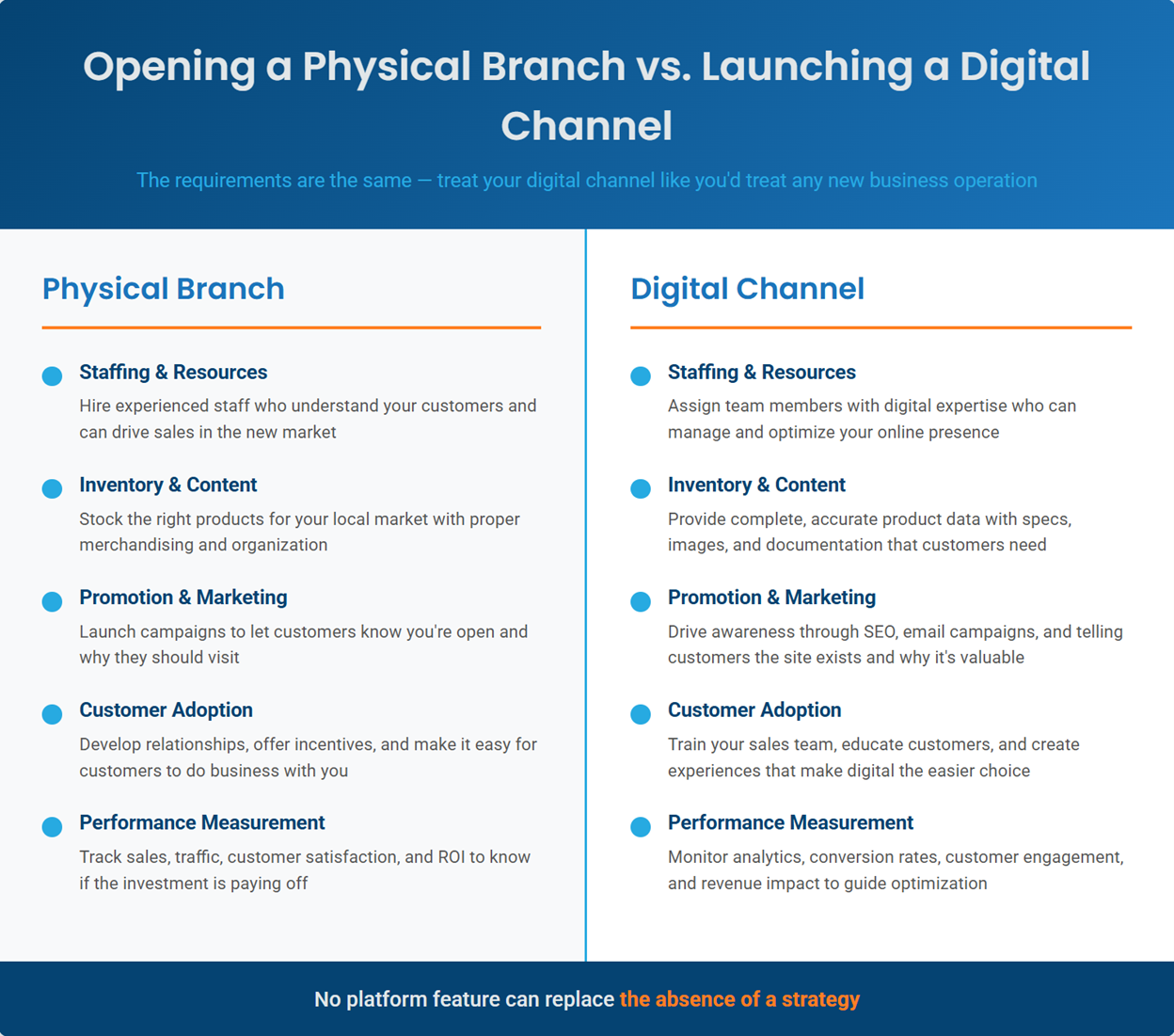
Here’s an analogy we use with clients that tends to cut through the noise: think of your website as a new branch location.
If you were opening a physical branch in a new market, you wouldn’t unlock the doors and expect business to materialize. You’d staff it appropriately, stock the right inventory, promote it to targeted customers, and develop a plan to drive adoption. You’d treat it like a business initiative, because it is one.
The digital channel demands the same thinking. Without it, even a well-built site sits idle. Existing customers keep calling their sales rep. New customers never find you. And when results disappoint, the instinct is to blame the platform.
The hard truth is that no feature in any eCommerce platform will solve the absence of a strategy.
The Assessment Step Nobody Wants to Skip Twice
Most companies that come to us a second time have one thing in common: they skipped doing a formal assessment the first time around.
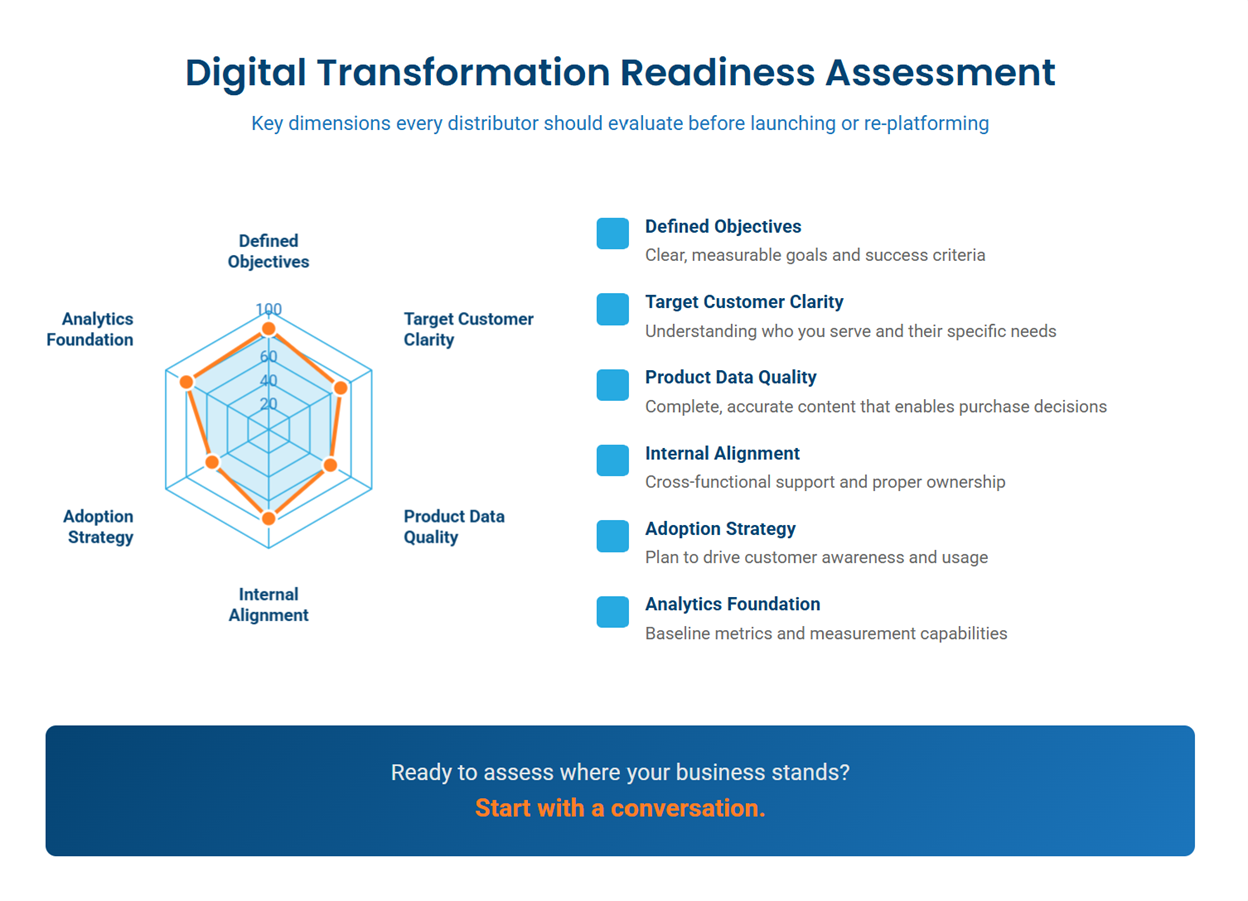
Before any implementation begins, the right questions have to be answered. What does success look like (specifically, measurably) and over what timeframe? Who is the target customer, and what do they need from a digital experience that they aren’t getting today? What does your product data look like? What are your competitors doing online, and how are your own customers using those sites?
Assessing these questions thoroughly, honestly, and completely is the foundation that determines whether the investment pays off. The businesses that define their objectives upfront are the ones that can point to results 12 months later. The ones that skip it typically spend that same year wondering why the site isn’t performing.
We’ve seen $100 million companies want to build a site for $20,000 and call it done. We’ve also seen $25 million distributors invest meaningfully in a proper digital strategy and compete effectively against others many times their size.
Revenue isn’t the indicator of readiness. It’s a combination of understanding and commitment.
Your Differentiator Has to Exist Online, Too
Ask any mid-market distributor what sets them apart from the national competitors, and the answer is almost always the same: Service. Product knowledge. Speed. Relationships. The ability to pick up the phone and actually solve a problem.
And yet, when those same companies go online, they go online as a commodity: a searchable catalog, a cart, a checkout. Everything that makes them different in person disappears the moment a customer visits their site.
That gap is the real opportunity. 73% of today’s B2B buyers are millennials who prefer online self-service over traditional sales interactions (Swell, B2B Marketplace Trends, 2025). They’ll call your rep to place a routine order if they have to, but they’d prefer to accomplish it online.
The question is whether they’re finding an experience that reflects the value your business actually delivers, or whether they’re looking at a catalog that could belong to anyone.
The goal isn’t to replicate what your competitors do at scale. It’s to carry your unique advantages into the digital channel and build an experience that a national player can’t match. Customer-specific tools. Industry-relevant functionality. Content that speaks to what your customers are actually trying to accomplish on the job.
That is what a digital transformation looks like in practice — not a platform decision, but a deliberate effort to extend the value you already deliver into a channel that more and more of your customers are expecting.
The Right Time to Start
Gartner predicted that 80% of B2B sales interactions would occur through digital channels by 2025, and that milestone has arrived. Your customers are already buying online. The question is whether they’re buying from you.
The businesses that approach digital transformation as a true business initiative, one with clear objectives, the right internal alignment, and a partner who understands the wholesale distribution model, are the ones building something durable. Not just a website, but a digital channel that drives measurable revenue, accelerates customer adoption, and supports the organizational goals that matter most to your business long after launch day.
Curious where your business stands? Start with a conversation.

Related News & Insights
 Podcast
Most manufacturers and distributors already know they need to do something about artificial intelligence. Few know…
 Insights & advice
A few months ago, I was reading a set of proposed AI agent use cases from…
 Insights & advice
Hiram Bingham didn’t wander into the Peruvian Andes and stumble across Machu Picchu. He planned an…
 Insights & advice
Tonia Coletta spent fifteen years in the beer industry before she ever thought seriously about millwork….
 Podcast
For most of B2B, eCommerce adoption has followed a predictable arc: early skepticism, gradual experimentation, and…
 Insights & advice
Brooke Logan did not set out to work in B2B eCommerce. Her degree is in biology….