

 Podcast
Why Piers Gorman Says B2B Payments Are the Most Overlooked Lever in Digital Transformation

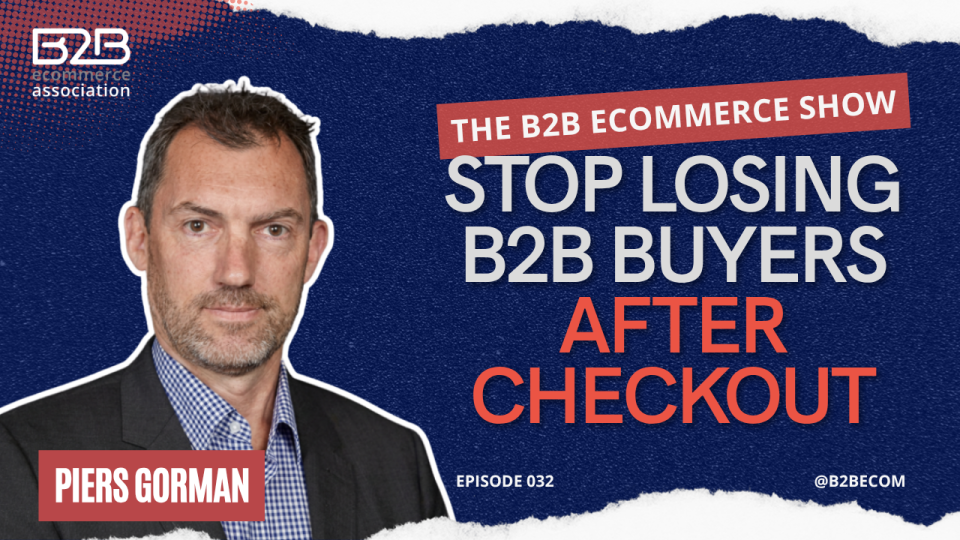
TreviPay’s Piers Gorman on the expectation gap between buyers and sellers, the fraud landscape reshaping credit decisions, and why payments belong in the digital transformation conversation from day one.
In a recent episode of The B2B eCommerce Show, host Justin King sat down with Piers Gorman, Senior Vice President, APAC and EMEA, at TreviPay, the company that helps manufacturers, distributors, retailers, and marketplaces simplify B2B payments, invoicing, and trade credit across global markets. The conversation covered a range of issues that manufacturers and distributors face when modernizing their order to cash process, from the silent friction buyers experience after checkout to how artificial intelligence is reshaping both fraud prevention and growth.
What emerged from the discussion was a clear message: payments are not a back office function bolted onto digital transformation. They are part of the customer experience, and often the part that decides whether a buyer comes back.
The Expectation Gap Between Buyers and Sellers
Gorman’s path to B2B payments runs through eight years in the British Army, a defense consultancy he helped build in Abu Dhabi, and stints across Cape Town and Singapore before landing in Melbourne with TreviPay. King opened the episode by noting how often that kind of background shows up in this industry. “I think it’s interesting military, the people that I’ve met coming from the military and that spent not just a couple of years in the military, you know, this idea of complexity, you know, always fits really, really well into your world,” King said.
King then turned to what he called “this expectation gap in B2B e-commerce,” asking where buyers and suppliers see the same transaction differently. Gorman’s answer centered on friction.
“The consistent theme was the needs to reduce friction, right? To make it as seamless as possible for me to buy from you,” said Piers Gorman, SVP APAC and EMEA, TreviPay.
That expectation, he explained, does not stop at the shopping cart. It carries through to how invoices are formatted, how purchase orders are matched, and how quickly a buyer’s credit line reflects a payment that already cleared. The complexity scales with the size of the buyer. Gorman described a hotel chain that needs invoices broken out by property for reconciliation, or a buyer who requires a specific purchase order format before an invoice will even be accepted into their system. Sellers who cannot meet those requirements are not losing on price or selection. They are losing because they made it hard to do business with them.
King connected this directly to a theme B2BEA has written about before: customer adoption depends on whether the entire purchasing journey, including the parts finance teams own, is built around what customers actually need. You can read more about how B2B companies are navigating digital priorities under pressure in B2BEA’s guide on driving B2B eCommerce adoption.
Why Finance Gets Left Out of the eCommerce Build
One reason the expectation gap persists, according to Gorman, is organizational. Finance teams are typically built to protect the business, not to improve the customer’s experience.
“The accounts receivable function is a finance function, right? It’s seen as a protects the organization mechanism rather than a customer experience mechanism,” said Piers Gorman, SVP APAC and EMEA, TreviPay.
That framing shapes priorities. A finance leader is trained to ask how to avoid bad debt, not how to help a customer buy more. Gorman was candid about how TreviPay itself gets misread by the businesses it works with. “We sometimes get characterised as just another payment method, like accepting a card,” he said. “It’s a much more complex, positively complex engagement. We need to be thought of as if we’re the in-house accounts receivable team of that client.” King agreed immediately, calling it “a really good point.”
This is a familiar pattern to anyone who has tried to launch or scale a B2B eCommerce platform. Commerce and finance often build in parallel rather than together, and payments end up addressed late, if at all. B2BEA’s own research backs up how costly that gap can be. A 2024 study from Hokodo, B2BEA, OroCommerce, and Greenwood Consulting found that 83 percent of B2B buyers would abandon a purchase if payment terms were not offered at checkout, and only 2 percent of buyers said they faced no issues at checkout at all.
The data outside B2BEA’s own research tells a similar story. Research compiled by Resolve found that 57 percent of B2B buyers abandon a purchase when checkout takes too long, a number that should worry any manufacturer or distributor still relying on manual credit applications and PDF forms that cannot be filled out digitally.
What Bad Friction Actually Looks Like
King pushed Gorman to get specific about what a poor experience feels like from the buyer’s side. He had set up the question by describing the kind of paperwork still common in the industry. “There’s a lot of archaic process in the industry, 35 page finance, uh, uh, things that people have to fill out applications, PDFs that aren’t even like fillable. You have to hand write them, you know, all the, all the crazy things,” King said.
“That whole experience, you’re going to feel like you’re lost in the system,” said Piers Gorman, SVP APAC and EMEA, TreviPay.
He contrasted that with the kind of constant, transparent communication a buyer expects from a modern consumer brand. The friction does not end after onboarding. Gorman pointed to payment application as one of the more painful, hidden bottlenecks in B2B commerce. A single invoice might carry hundreds of line items tied to dozens of children accounts, and applying that payment correctly can take weeks. Meanwhile, the buyer’s credit line stays frozen even though the money has already moved. “You can’t spend because your credit limit has been blocked because they pay the money but it’s just not been applied,” he said. That kind of delay is not a minor operational inconvenience. It directly affects whether a customer keeps buying.
Composable Commerce Needs a Payments Layer
As more manufacturers and distributors move toward composable commerce, assembling best-of-breed tools for search, content, and checkout instead of relying on one monolithic platform, payments increasingly function as connective tissue rather than a single checkout step.
“It’s the outsourcing of the net terms solution for our clients, and where it’s a network structure, the network of their sellers,” said Piers Gorman, SVP APAC and EMEA, TreviPay.
That model matters most when a seller’s buyer network is itself complex. Gorman pointed to a TreviPay client with roughly 4,500 franchise locations across the United States, where a large buyer could end up managing thousands of individual seller relationships. TreviPay’s job, as he described it, is to make that feel like one coherent relationship from both directions, simple for the buyer and manageable for the seller. This kind of unified buying experience is showing up across B2BEA’s broader research too. A case study on Doyon Després’ omnichannel growth strategy describes how the Canadian foodservice distributor unified operations across channels while keeping flexibility for both retail and B2B buyers, a similar instinct to what Gorman described for payments infrastructure.
Identity, Credit, and the Fraud Problem Hiding in Checkout
Extending credit to an unknown buyer arriving from a browser is its own challenge, and Gorman did not minimize it. He pointed to the current fraud landscape, where identity theft and AI enabled fraud attempts have become significantly more sophisticated. TreviPay’s answer is heavy investment in real-time identity verification and credit decisioning, fast enough in some markets to approve a new applicant and extend a credit line up to 100,000 dollars in under 30 seconds.
That investment is not optional. Industry data shows fraud sophistication accelerating quickly. Research from BNY found that the share of identity fraud attempts classified as advanced nearly tripled in a single year, climbing from about 10 percent in 2024 to 28 percent in 2025. For manufacturers and distributors building self-service credit into their eCommerce platforms, that is not an abstract risk. It is a daily operational reality that demands the kind of layered identity and credit infrastructure Gorman described.
Localization Is Not Optional for Global Expansion
King asked what gets standardized and what has to flex when a B2B seller expands into new markets. Gorman’s answer was direct: almost everything related to payments has to localize. Currency, compliance regimes, credit data sources, and even preferred payment methods all vary by country. He pointed to the United States, where TreviPay still processes roughly 100,000 checks per quarter, compared with Australia, where checks are not accepted at all. Europe’s real-time payments infrastructure, he noted, is well ahead of both markets.
“You need to offer the payment methods to your customers that make sense in that country. Otherwise you’re buying April versus your competition,” said Piers Gorman, SVP APAC and EMEA, TreviPay.
The same logic applies to language requirements, citing Canada’s need to support both English and French as one example of how localization touches more than currency conversion. Localization isn’t limited to payments either. Buyers increasingly expect a consistent experience across every channel they use to interact with a supplier, not just the one they happen to check out on. McKinsey’s 2024 B2B Pulse survey found that buyers now use an average of ten different channels across a purchasing journey, up from roughly five in 2016, underscoring why a fragmented experience between web, sales rep, and finance teams creates real friction long before a buyer ever reaches checkout.
Where AI Fits Into B2B Payments
Asked about artificial intelligence, Gorman noted that most of the industry’s current investment is defensive, aimed at fraud prevention and protection. TreviPay is taking a parallel but different approach with a tool it calls the Growth Center, which applies AI to spend pattern analysis so the company can flag buyers who appear to be reducing their activity before that decline becomes a lost account.
“AR doesn’t need to be a cost center. It can be a value add to the business, not just a protection mechanism, a lever to unlock growth,” said Piers Gorman, SVP APAC and EMEA, TreviPay.
That framing matters for any manufacturer or distributor weighing where to apply AI first. The instinct is often to start with fraud detection, and for good reason. But Gorman’s point is that the same data infrastructure built to catch problems can also be turned toward identifying opportunity.
What Practitioners Should Take From This
For digital leaders at manufacturers and distributors, Gorman’s advice was less about adopting new technology and more about organizational alignment. The eCommerce channel tends to set the pace for a company’s broader digital transformation, which means it needs buy-in from finance, operations, and leadership rather than treating payments as someone else’s problem to solve later.
“If you just leave them out there at a distance, then you’re not going to get the best out of them,” said Piers Gorman, SVP APAC and EMEA, TreviPay.
King added a useful reframe for anyone trying to build internal support for this kind of project, pointing out that payment and credit modernization is an opportunity to pull in stakeholders across the business, from purchase order matching to shipment tracking, who may not have been part of the original eCommerce build. The point echoes a theme B2BEA has examined elsewhere: B2B eCommerce projects tend to stall not from a lack of investment, but from a lack of alignment. A recent B2BEA piece on why B2B eCommerce projects fail quotes King making nearly the same point in a different conversation: “Executive alignment and customer adoption are the real issues across the industry, big companies, small companies. It really doesn’t matter.”
The Long Arc of Modernizing B2B Payments
Gorman closed with a reminder that B2B is not a single, uniform buyer base. “The workshop manager still wants to fill in a paper docket,” he said. “And you have to be educated for that. But you also want to deal with the young guy that’s joined a sister business that only knows his phone.” Suppliers, he argued, need to serve both ends of that spectrum at once, and do it at pace. King’s closing exchange with Gorman captured the gap perfectly: a vision of fax machines sitting right next to AI agents for years to come, the entire spectrum of B2B payments modernization happening at once rather than in a clean, linear handoff.
Gorman’s central argument is straightforward even if the execution is not. B2B buyers judge a supplier on the entire transaction, not just the parts that are visible on the website. The friction that lives in invoicing, credit, and payment application may be invisible to most of an organization, but it is highly visible to the buyer experiencing it. As more B2B eCommerce platforms move toward composable, customer-led architectures, payments and credit infrastructure deserve a seat at the table from day one, not a retrofit after the storefront launches.
About the Guest: Piers Gorman is Senior Vice President, APAC and EMEA, at TreviPay, where he helps manufacturers, distributors, retailers, and marketplaces simplify B2B payments, invoicing, and trade credit across global markets. Before entering B2B payments, he served eight years in the British Army and later helped build consulting businesses supporting organizations across the Middle East and Africa. Connect with Piers Gorman on LinkedIn.
About the Host: Justin King is Global Managing Director of the B2B eCommerce Association, Chief AI Officer, and host of The B2B eCommerce Show. He has been writing and speaking about B2B eCommerce since 2007.

Related News & Insights
 Podcast
Most manufacturers and distributors already know they need to do something about artificial intelligence. Few know…
 Podcast
Most manufacturers and distributors still think of loyalty as a rewards program: points, rebates, a discount…
 Podcast
The founder and CEO of Luminos Labs has spent 16 years watching digital commerce projects stall…

 Insights & advice
Article Four of Four — The B2B Ecommerce Association White Paper Series on PIM Innovation The…
 Podcast
For most of B2B, eCommerce adoption has followed a predictable arc: early skepticism, gradual experimentation, and…
 Insights & advice
The acceleration of digital commerce has unlocked new opportunities for retailers and B2B merchants, including manufacturers…