

 Insights & advice
Teresa Herrmann on Building B2B eCommerce in Hydraulic Manufacturing

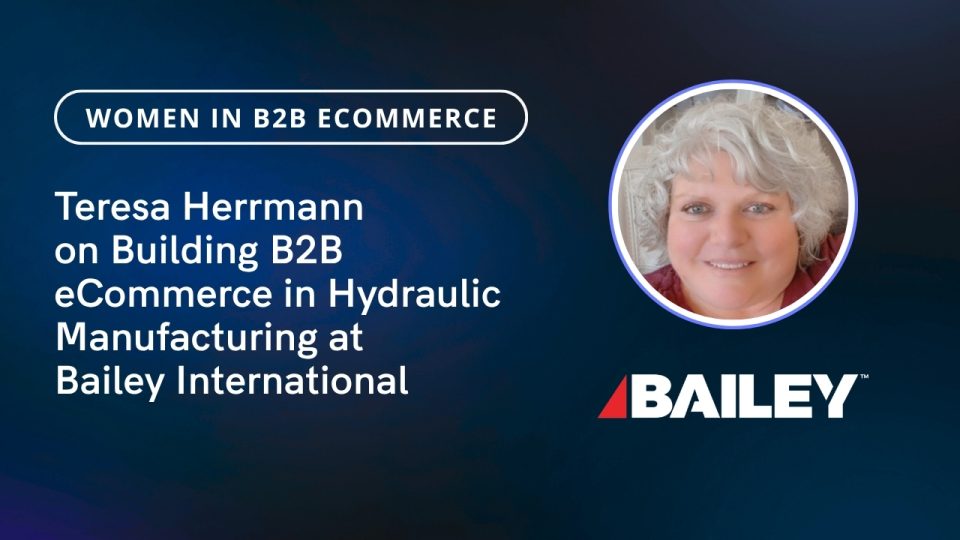
Teresa Herrmann manages digital commerce at Bailey International, a Knoxville-based manufacturer and distributor of hydraulic cylinders, pumps, motors, and valves, where she helps build the company’s eCommerce program across its website, Amazon, and eBay channels. She came to manufacturing through customer service, and brought with her a background in luxury hospitality at Blackberry Farm in East Tennessee, where she developed the habit of learning the systems she worked in well enough to teach them. Her conversation with B2BEA as part of the Women in B2B eCommerce series covers multi-channel catalog management, the data work that determines whether digital commerce performs, and what it looks like to build eCommerce expertise over time in a technical product category where accurate specifications are fundamental to the customer experience.
From Luxury Hospitality to Hydraulic Manufacturing
The common thread across Herrmann’s career, in both luxury hospitality and hydraulic manufacturing, is an ability to go deep in the systems she works with and learn them well enough to improve them. At Blackberry Farm, she started as a reservations manager and moved into revenue management, eventually becoming a super user for the resort’s property management system when the property transitioned platforms. “I had to learn very quickly so that I could help them too,” she said. That instinct has carried forward at every stage of her career since.
A relocation to Knoxville after her marriage opened the door to Bailey International, where the conversation about joining centered on service, not product knowledge. “Service is service, as long as you can make the customers happy,” the HR director told her. Herrmann interviewed with the VP of Sales and the CFO, took the role, and started as customer service manager. “After I got through being terrified of hydraulics, I decided I can do this,” she said.
Her first significant systems challenge at Bailey was a transition to NetSuite that kicked off on her first day, and which carried with it complications of a data migration with little clean up combined with a lot of scripting to the new system to act as much like the old system as possible. “There was a lot of clean up to do after everything was migrated from AS400 into NetSuite.” That early encounter with lack of data clean up, added scripting and its downstream consequences would shape how she thought about the eCommerce work that was still several years away.
The Amazon Reconciliation That Changed Her Career
Herrmann came to eCommerce the way many B2B practitioners do: through a gap that opened up and a willingness to fill it. A member of the technical support team had, as part of his responsibilities, been reconciling Bailey’s Amazon payments to the accounting system, and when he announced his departure, Herrmann made a decision that turned out to reshape the next decade of her career. “Just before you leave, teach me everything that you do about it,” she said.
From Amazon reconciliation, her responsibilities expanded to include the Amazon store as a whole, and then an eBay store that was managed entirely manually, without a connector to synchronize inventory. “You had to make sure that your inventory was exactly like it was on the website so that you didn’t oversell,” she said, and the operational burden eventually became unsustainable. Bailey’s eBay presence was suspended. Today the eBay store is reinstated, running with a connector that keeps inventory synchronized, and the company operates across three channels: its own website, Amazon, and eBay, with approximately 4,500 SKUs on the site and 2,500 on Amazon. The expansion from channel management into site-building happened through the marketing department, which went through a leadership transition that drew Herrmann more deeply into the website development process. When Bailey hired an eCommerce director in 2021, she transitioned fully into eCommerce, where she has worked since. “That was probably when I got hooked, because it was challenging and tough, but once it was done, it was such an overwhelming feeling of accomplishment,” she said.
Two Website Builds, a Data Problem That Followed Every Step, and the Work in Progress Now
Bailey International has built two eCommerce sites during Herrmann’s time in the function. The first was built on SuiteCommerce Advance, integrated with NetSuite, and was constrained from the beginning by the condition of the data inside the ERP: records migrated from the legacy AS400 system without cleanup, which made catalog structure and product content harder to build reliably. The second site, launched on BigCommerce after an evaluation process led by the eCommerce director, took nearly a year to go live, rather than the six months the team had projected, largely because scripts written over the years to make NetSuite behave as the old system had accumulated into a layer of technical complexity that slowed every integration decision.
The BigCommerce site has been live for roughly two and a half years, and the current focus is on the audit work that tends to follow a major platform launch: making sure the data is actually right. In hydraulics, that urgency is concrete. “With hydraulics, if a spec is wrong, it could cause major problems in a whole system,” Herrmann said. Product photography has been another priority, and the team has been methodically replacing them with new, multi-angle photography across the catalog.
The work in progress as of this year includes two initiatives aimed at improving the experience for Bailey’s customers. The first is a B2B portal feature that allows qualified OEM customers to log in and see their custom proprietary parts, even for products that cannot yet be ordered online, giving them a way to identify part numbers and initiate conversations with the sales team. The second is a layout for cylinder product pages that surfaces bore sizes, stroke lengths, and key specifications in a single view rather than requiring customers to click through multiple pages to compare options. Both projects reflect the same underlying goal: making the website worth using for the customers who drive the most volume.
AI in Practice: Product Descriptions, a Conference Presentation, and One Feature That Changed How She Works
Herrmann came to AI adoption gradually and credits a specific presentation with accelerating the shift. Before attending the B2BEA conference in Scottsdale, she was using AI primarily for product content, feeding it product information and using the output as the basis for catalog descriptions. “I’ll feed it the information that it needs and it writes a beautiful description,” she said. The presentation that changed her sense of what was possible came from Nick Pericles, whose demonstration of AI capabilities across multiple platforms left a strong impression. “I was floored,” she said. “I just had no idea.”
One feature stood out: the ability to switch between a standard response mode and a deeper reasoning mode. “You can change it to thinking as opposed to a fast response, and I never would have known that if it weren’t for him,” she said. The practical implication, that the same tool can produce qualitatively different outputs depending on how it is configured, was something she had not previously considered. She has since expanded her use of AI to include spreadsheet analysis, finding that the ability to upload a file and describe what she needs has made certain analytical tasks substantially faster. “It’s really been eye-opening for me,” she said.
Women in B2B eCommerce: The Room That Surprised Her, the Perspective She Brings, and the Advice She’d Give
When Herrmann walked into Bailey International for the first time, it was, she said, “a sea of men.” Manufacturing is not a field that has historically drawn many women in operational or technical roles, and she did not arrive expecting otherwise. What she did, from her position as customer service manager, was hire deliberately. “I started hiring women for the customer service part of it,” she said. “If you have the attitude and the service-mindedness, you can learn the technical part.”
On the eCommerce team, which is a team of three, Herrmann works alongside two colleagues and finds that her customer service background gives her a frame of reference that is not always shared. Customers in Bailey’s market still want paper catalogs, still call on the phone, and still expect a website that functions correctly on a mobile device. “I still know that customers want a catalog; they want paper, still, to this day,” she said. That customer-facing sensibility, she believes, is part of what she brings to a function that can otherwise be absorbed entirely by technical and operational concerns.
The Women in B2B eCommerce dinner at the B2BEA conference in Scottsdale was a meaningful moment. “It did my heart good to see so many women in our profession,” she said. “It may be male-dominated, but that’s not going to keep me from doing it.” Her view of the field’s trajectory is measured: she expects more women to enter over time, particularly in buying and procurement roles, and believes the technical nature of the work suits people who approach it with genuine curiosity rather than apprehension. “People who have that feeling of, I wonder if I could fix that, or I wonder what causes that to happen, and start digging in: those are the types of people that B2B eCommerce is a great fit for, because it’s all about working on the back end to see what happens on the front end,” she said.
The advice she would offer to women considering careers in the field is practical: speak up. Herrmann is candid that this is something she has had to work at deliberately. Through a personality framework her company uses called GiANT, she recognized that she often holds back opinions even when she has a considered view. Knowing that about herself helped her become more intentional about contributing her perspective, particularly in the continuous improvement process Bailey uses to surface and resolve recurring operational problems. “Just don’t be afraid to challenge the status quo,” she said. “Don’t be afraid to say something if you see something.”
Teresa Herrmann was interviewed as part of B2BEA’s Women in B2B eCommerce series, a program dedicated to profiling practitioners, operators, and leaders shaping digital commerce in manufacturing and distribution. To connect with others in the network, join the Women in B2B eCommerce LinkedIn group. Upcoming Women in B2B eCommerce events will take place alongside major B2BEA gatherings in the United States, Australia, and Europe in 2026.
Related News & Insights
 Podcast
Adrienne Hartman has spent 26 years turning technical instinct into business judgment, and 19 of those…
 Podcast
Lorrie Mizuko did not grow up with a clear picture of where she was headed. Her…
 Insights & advice
For manufacturers and distributors managing large, complex product catalogs, the gap between the data that exists…
Replatforming is rarely just a technology project. It is an operational transformation initiative that touches pricing…
 Insights & advice
Article Four of Four — The B2B Ecommerce Association White Paper Series on PIM Innovation The…
 Insights & advice
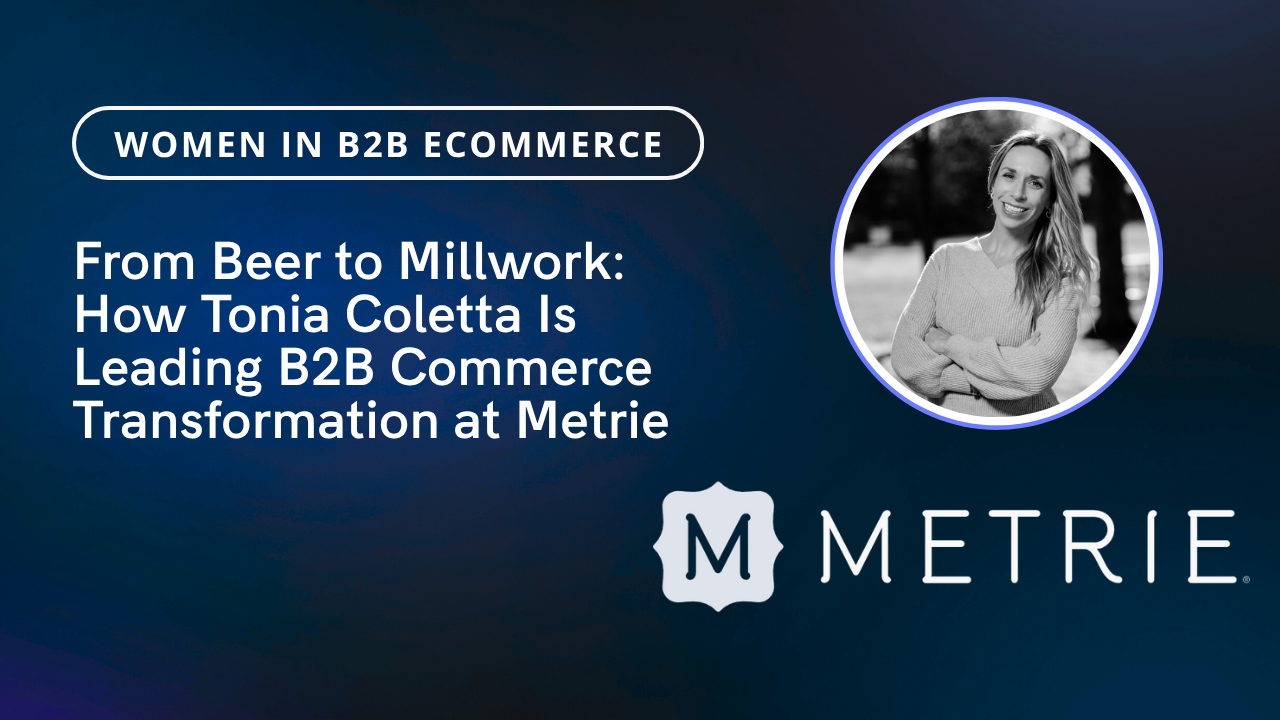
Tonia Coletta spent fifteen years in the beer industry before she ever thought seriously about millwork….