

 Insights & advice
25 Years of B2B Commerce and a New Ambition: How Shannon Zonca Is Transforming Digital at MillerKnoll

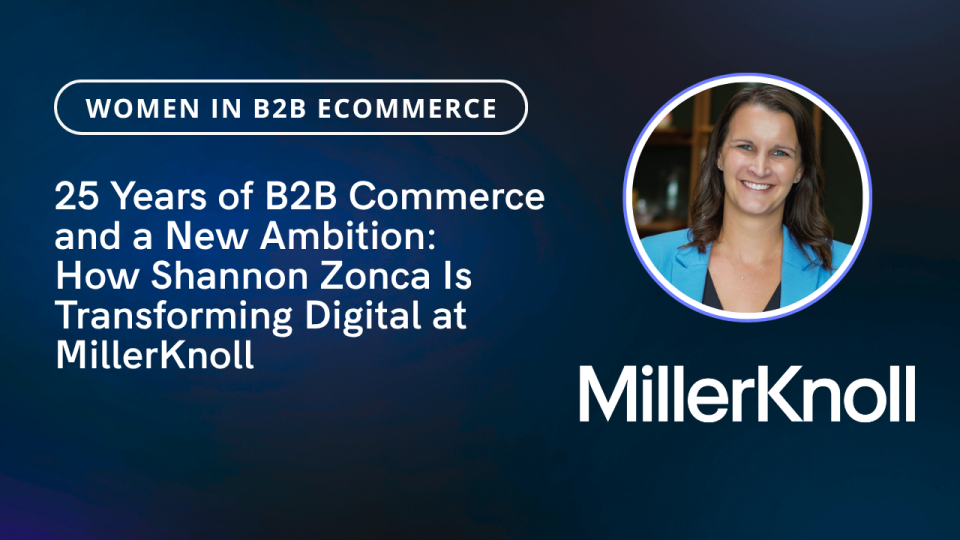
MillerKnoll has been doing B2B eCommerce for more than twenty-five years. That tenure, spanning multiple platform generations, the shift from static catalogs to integrated procurement systems, and now an AI-powered design tools layer, is unusual in any sector. In the commercial furniture industry, it is remarkable.
Shannon Zonca is VP of B2B Commerce and Digital Solutions at MillerKnoll, the design-driven furniture manufacturer whose portfolio includes Herman Miller, Knoll, DWR (Design Within Reach) and a collection of other globally recognized brands. Her team encompasses B2B eCommerce, global brand websites, and a suite of tools that support the company’s dealer and design community across the full arc of a commercial furniture project, from initial budget planning through product specification, procurement, and delivery.
I spoke with Zonca at the B2B eCommerce Association’s Americas event in Scottsdale, during the Women in B2B eCommerce dinner. The conversation covered PunchOut commerce, AI-driven space planning, the challenge of unifying product data across a multi-brand portfolio, and what it takes to build internal executive alignment behind a digital transformation agenda. It is a conversation worth having more broadly, because MillerKnoll’s journey maps onto challenges that manufacturers across many categories are navigating right now.
Twenty-Five Years of B2B eCommerce: How the Mandate Has Evolved
MillerKnoll’s B2B eCommerce program did not start with a vision of seamless digital experience. It started with a practical problem: how do you make it easier for large enterprise customers to purchase furniture through the procurement systems they already use?
“In the early days, the goal was pretty simple: connect into our customers’ procurement systems and make it easier for them to buy the way they already work,” Zonca said. The answer was PunchOut integration, a technology that embeds a supplier’s eCommerce experience directly inside a customer’s enterprise procurement platform (such as SAP Ariba or Coupa), allowing buyers to select products without leaving their own systems.
Twenty-five years later, PunchOut remains the primary channel of B2B eCommerce business at MillerKnoll, and the mandate around it has grown considerably.
“PunchOut is our primary B2B eCommerce channel, supported by our dealer partners. And increasingly, it’s not optional. For many customers, it’s simply a requirement to do business,” says Zonca.
The value is bilateral. PunchOut makes purchasing easier for large enterprise buyers who want to stay inside their existing procurement workflows. It simultaneously reduces order management burden for the dealer partners who fulfil those orders. “We really see it as a win across the board for customers, dealers, and our internal teams,” she said.
The White Glove Onboarding Model
Commercial furniture is not a category where a standardized onboarding template can do the job. Every enterprise customer has different contract pricing, different product standards, different space requirements, and a different dealer partner managing the relationship.
“We take a very white-glove approach to onboarding. Each customer is assigned an eCommerce onboarding consultant who works closely with both the client and the dealer to understand product standards, how they do business, and who needs access. From there, we tailor the experience to fit their needs.”
The configuration work is supported by a PIM system (a product information management system, the single source of truth for product data) that powers the merchandising content, contract pricing, and catalog structure for each customer deployment. Once configured, the team runs the experience through a full testing process with both the client and the dealer before go-live, followed by hands-on training.
Customer adoption timelines vary. Some customers use the platform primarily for what Zonca calls “day 2 purchasing,” meaning ongoing replenishment orders after an initial office buildout. Others run large, project-based orders through the platform. “Typically, within six months to a year, we start to see customers reach a steady, normal run rate of business on the platform,” she said.
The approach is resource-intensive, but it has been demonstrably successful. The investment in proper onboarding, in Zonca’s view, is what converts a technology deployment into a commercial relationship. The customer experience work that drives durable adoption in dealer-supported B2B models consistently depends on this kind of hands-on enablement at launch.
AI That Does Five Days of Work in Two Hours
MillerKnoll’s use of AI extends well beyond the productivity tools that most B2B organizations are currently exploring. The company has been building AI-powered capabilities into its dealer and design tools suite, including a space planning and optimization tool that carries patent protection for what the team has developed.
The example Zonca described is specific enough to be genuinely instructive. In commercial real estate and workplace design, a “test fit” is a preliminary exercise that maps how many employees a space can accommodate and what budget should be planned for both the space and the furniture. Traditionally, this work requires a dealer designer and takes several days.
“We had someone input a small set of data, ran it through our proprietary AI tool, and had results in two hours. We ran the same work through the traditional process with a dealer designer, and that took five days,” Zonca said.
The team has also built a chat tool within one of its product discovery platforms, allowing dealers to query the full MillerKnoll portfolio in natural language. “A dealer can say, ‘I’m responding to an RFP and need a chair that meets specific criteria. What do you have across the portfolio? And it’ll search from the hundreds to thousands of products that we have, and it’ll recommend the top products that meet those criteria,” she said.
These are not proof-of-concept experiments. They are in production, developed by an in-house digital product team with one long-term external AI expert embedded in the work. The internal approach has kept the capability proprietary and the iteration cycle tight.
Unifying a Multi-Brand Data and Technology Stack
MillerKnoll is not a single brand. It is a portfolio of design brands, including Herman Miller and Knoll, that came together through acquisition and have historically maintained separate product data, digital platforms, and customer-facing tools. The challenge of unifying that stack, while preserving what makes each brand distinctive, is one of the defining strategic problems Zonca’s team is working through.
“As these brands have come together, we have information and data in many different places. We’ve been focused on how we streamline that so customers can get to product discovery faster and access the information they need. At the same time, we’re ensuring our dealers have the right data to confidently specify MillerKnoll products.”
The broader organizational direction is toward consolidation. “We’re really working on moving towards unifying as much of our data and technology stack as possible so that it can be as scalable as possible,” she said. The PIM investment, the product discovery chat tool, and the AI-powered space planning work are all downstream of that data unification effort. Clean, connected product data is the prerequisite for every customer-facing capability the team is building.
Building the Business Case and Getting Executive Buy-In
One of the more practical threads in our conversation was Zonca’s account of how MillerKnoll’s digital transformation got real organizational support. The answer was not a top-down mandate. It was a combination of bottom-up advocacy and the good fortune of having strong executive leadership with retail eCommerce experience in their backgrounds.
“I put together a business case and went to our executive team with a clear view of what we wanted to do, what it would cost, and what we believed the return and business growth would be,” she said.
The result is a leadership team that has made digital transformation part of the company’s key growth strategies, not a side initiative managed by a small team trying to prove its value. “It really does take both sides. It takes people championing the opportunity from the ground up and clearly articulating the business impact for customers and dealers. And it takes leadership that understands the power of digital and is willing to invest in it,” Zonca said.
That two-directional dynamic, practitioners building the case from the ground up, leadership providing strategy-level buy-in, is the pattern that produces durable digital investment rather than one-time projects.
Advice for the Next Generation of B2B Digital Leaders
I asked Zonca what she would tell someone earlier in their career, or still in school, who wants to be ready for the kind of work her team does. Her answer focused on disposition rather than curriculum.
“The most important thing is the ability to continuously learn and evolve. Anyone who wants to grow in this space needs natural curiosity and a willingness to test, learn, and innovate. The pace of change is rapid, and the tools and platforms we work with continue to evolve almost daily. You have to be comfortable experimenting, staying agile, and learning as you go,” she said.
Her own path is worth noting. She studied advertising and communications, drawn to the numbers and business side of the discipline, which eventually led her into eCommerce. The specific degree mattered less than the orientation toward problem-solving and the comfort with combining creative and analytical thinking. That combination, creative enough to see what experiences could be, analytical enough to build the business case for them, is what the role requires.
The Women in B2B eCommerce Community
Zonca attended the B2B eCommerce Association’s Americas event in part because of the Women in B2B eCommerce community it has been building. She spoke at our panel at the Women in B2B dinner and described the conference as a genuinely valuable place to connect with others navigating the same challenges from the inside.
“I’m really interested in connecting with others in the B2B eCommerce space, learning best practices, hearing what others are doing, and sharing openly. We’re always looking to bring new ideas back to the team and make sure we’re staying ahead of what’s next,” she said.
The B2B eCommerce Association’s Women in B2B eCommerce program is designed for exactly this kind of peer exchange. If you are a woman working in B2B digital commerce, or a leader in manufacturing or distribution looking to connect with others building similar capabilities, the Women in B2B eCommerce LinkedIn group is an active community. You can connect with Shannon Zonca on LinkedIn.
Looking Ahead
MillerKnoll is not a company still trying to figure out whether B2B eCommerce matters. It is a company more than twenty-five years in, with ambitious growth targets, a multi-brand data unification program underway, patented AI capabilities in production, and a VP whose team spans eCommerce, global websites, and a full suite of dealer tools. The next phase is about unlocking the growth that all of that infrastructure makes possible.
“When I think about a big win, it’s really about unlocking growth,” Zonca said. “That means reaching more customers, expanding our capabilities, continuing to evolve the customer experience, and removing friction for both our customers and our internal teams.”
That framing, growth through friction reduction, reached simultaneously from the customer side and the internal operations side, captures something important about where leading B2B digital programs are headed. The most durable competitive advantages are not built by adding features. They are built by making the work of doing business easier for every participant in the value chain: the customer, the dealer, and the team managing it all.
After more than twenty-five years, MillerKnoll is still finding new ways to do exactly that.
Related News & Insights
 Podcast
Adrienne Hartman has spent 26 years turning technical instinct into business judgment, and 19 of those…
 Podcast
The founder and CEO of Luminos Labs has spent 16 years watching digital commerce projects stall…
 Insights & advice
Teresa Herrmann manages digital commerce at Bailey International, a Knoxville-based manufacturer and distributor of hydraulic cylinders,...
 Insights & advice
By Troy Sample, Vice President of Sales, and Dan Bronson, Partner, Digital Strategy and SEO, impaqX…
 Insights & advice
In B2B eCommerce, digital transformation rarely follows a straight line. Manufacturers and distributors face a layered…
 Insights & advice
Article Four of Four — The B2B Ecommerce Association White Paper Series on PIM Innovation The…