

 Podcast
How Lorrie Mizuko Built a B2B eCommerce Career by Saying Yes to the Unfamiliar

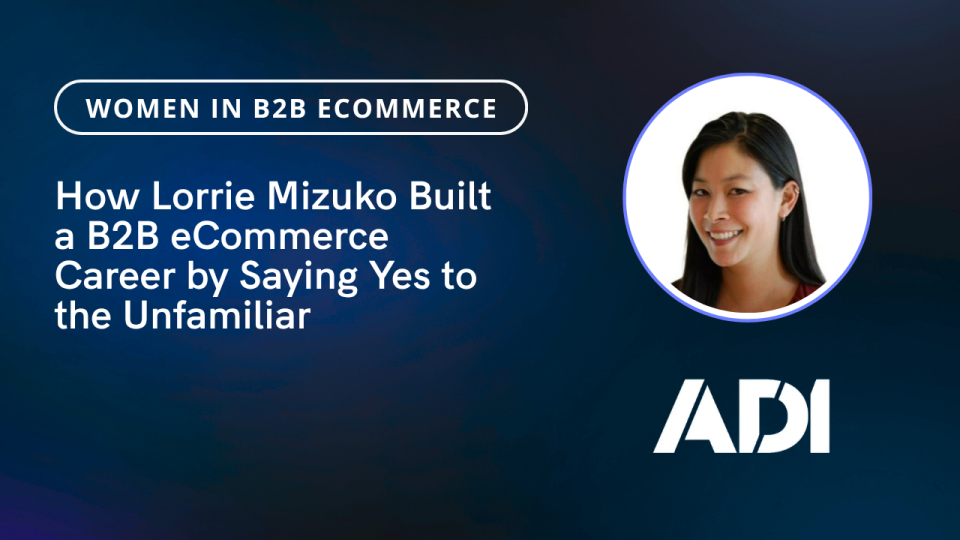
Lorrie Mizuko did not grow up with a clear picture of where she was headed. Her family expected something defined, something with a title people recognized. What she found instead was a career shaped by curiosity, built through relationships, and advanced by a willingness to take on roles she had never done before.
Today, Lorrie Mizuko is VP of Digital Marketing at ADI Global Distribution, a massive B2B distribution company and the 2025 B2B eCommerce Industry Award winner in the enterprise distribution category. In that role, she oversees all eCommerce revenue generated through the company’s websites and mobile app experiences, managing several branded platforms across a global footprint.
Mizuko joined the B2B eCommerce Association’s B2B E-commerce Show for a conversation with host Sarah Falcon about how she got here, what she has learned along the way, and what she is building next. The discussion is part of the B2BEA’s ongoing Women in B2B eCommerce series, which spotlights the women leading digital transformation across manufacturing and distribution.
A Career Built on Adjacent Moves
Mizuko’s path to B2B eCommerce did not follow a straight line. It started in traditional retail, moved through agency work, passed through a major consumer electronics manufacturer, and eventually landed in distribution. At each step, she made a deliberate choice to expand into something unfamiliar.
Her first digital role came through a connection she made while working in stores. “I went from traditional retail in the stores and met a couple of folks that were in the e-commerce space,” she recalled. “They were with an e-commerce platform provider and thought I would be great because I knew brick and mortar and they were starting to bring on customers trying to figure out how to ship physical goods through e-commerce sites.”
From there, she joined a digital marketing agency founded by the original team that built Target.com. The work gave her an early view of how brands were beginning to connect digital impressions to physical buying behavior, a problem that the industry is still refining today. She then moved to HTC, where she owned North American online sales for mobile and led the direct-to-consumer global launch of virtual reality technology across 20 countries, including a consumer financing partnership with TD Bank.
Each transition built on the last without fully replicating it. That pattern, Mizuko explained, was intentional.
Discomfort as a Signal, Not a Warning
When Mizuko joined Resideo, the Honeywell spin-off that is ADI’s parent company, she took on a full-stack digital transformation effort she had never led before. For some, that gap would have been disqualifying. For her, it was the point.
“When they talked about digital transformation, I thought, ‘Well, I haven’t done that yet,'” she said. “It was an opportunity to stretch and be uncomfortable, knowing that would grow you.”
Host Sarah Falcon noted the significance of that framing: “You said, ‘I haven’t done that yet.’ For some people, that’s a sign they should not move forward, but for you, it’s a sign something interesting is at play.”
Mizuko’s answer traced back to her time at Digital River, where she watched clients navigate digital transformations from the outside. “There’s always something that you can take away from something you’ve done before that will lead you down a curated path,” she said. “A lot of these things I hadn’t done before, but it felt like something I’d seen before.”
That ability to recognize patterns across contexts is a practical skill in B2B eCommerce, where the technology, the buyer expectations, and the organizational dynamics are always shifting. Research from McKinsey has consistently found that B2B digital leaders outperform their peers not because they had more experience with a given technology, but because they were faster at applying lessons from adjacent domains.
When she moved to ADI, the challenge shifted again. B2B eCommerce at that scale, with thousands of price books and complex credit-on-account structures, was new territory. “Being uncomfortable is when you’re growing,” she said.
The Art of Asking the Right Question
Mizuko described a consistent practice at the center of how she works: starting with the problem, not the solution. It sounds simple. In practice, it changes the outcome.
“I spend a good part of my day asking questions to figure out how we’re going to solve a problem,” she said. “Starting out with, ‘What is the problem that we’re trying to solve?’ Often people come to me saying they need to send an email tomorrow, but when you ask what they are trying to solve, it usually ends up that we don’t need to send that email because there are other ways to solve the problem.”
That orientation toward outcomes, rather than tactics, shapes how she evaluates whether a digital initiative will actually work. She is skeptical of rigid playbooks. “Every audience is different,” she said. “You should be open to the possibilities that you’re going to have to modify or change it and be willing to walk away from a solution because it just didn’t work.”
This approach aligns with what practitioners across B2B digital have found when it comes to customer experience design. A Gartner analysis of B2B buying behavior found that customers who felt supported through a purchase process, rather than pushed through a funnel, were significantly more likely to complete the transaction with low regret. Reducing friction requires understanding what buyers actually find difficult, not just optimizing the steps that are easy to measure.
Networking Without Being an Extrovert
Mizuko is direct about her own tendencies: she is not naturally an extrovert. But she built the skill deliberately, starting with a bartending job in college that forced her to be comfortable talking to strangers.
“Networking is about putting yourself out there at in-person events and cultivating those relationships over time, whether it’s through LinkedIn or a periodic note,” she said. “It’s so critical to work at it, and anyone can do it. You don’t need to be an extrovert.”
For professionals entering B2B eCommerce, she framed the network as a navigational tool. Her first role at Target came through a contact. Her move into digital commerce came through people she met in stores. The pattern held throughout her career: the next step came from someone she already knew, or someone who knew her work.
Falcon, who has spent her career at the intersection of B2B commerce and community, reflected on why that kind of deliberate relationship-building matters in this space. The B2B eCommerce world is still relatively small and specialized, which means reputations travel and relationships compound over time.
What It Means to Be a Woman in B2B eCommerce
When Falcon asked Mizuko about navigating a field that has historically been male-dominated, particularly on the technical side of distribution, Mizuko was candid.
“As a woman in technology, I’ve definitely been in rooms where I’m the only woman,” she said. “It’s not very common for women to be in leadership positions on the more technical side, but you have to build that second skin and show that you know what you’re talking about.”
She also noted a shift in the current moment. “What I love about B2B is that because everybody’s still learning, everybody is super open to having the conversation and asking, ‘How would you solve this?'” she said. “One of the biggest disruptors making people have their guard down right now is AI.”
Falcon agreed: “The level of openness is so different now than it was 10 years ago. Between COVID and AI, it’s become clear that the future is not going to look like the past.”
That openness creates an opportunity. The B2BEA’s Women in B2B eCommerce program exists to make that opportunity more visible and more accessible. The community includes a LinkedIn group where practitioners connect, share resources, and lift each other’s work into broader view. Mizuko’s story, and others like it, are exactly the kind of career evidence that helps the next generation of women see what is possible.
Research from Deloitte has found that companies with gender-diverse technology leadership consistently outperform their peers on innovation metrics, in part because diverse teams are more likely to surface the full range of customer problems rather than optimizing for the problems they already recognize.
ADI’s Digital Ambitions and the Simplicity Mandate
ADI is not a company in the early stages of digital adoption. It is a global distribution platform with multiple branded eCommerce experiences, a mobile app, and a recently validated record as one of the leading enterprise distributors in the industry. The question for Mizuko is not whether to go digital but how far and how fast to push.
Her answer is grounded in the customer. “The theme for my team this year is: everything that we’re doing should be with the mindset of how do I make my customer’s life easier,” she said. “We should make it a one-click purchase in the future.”
That kind of simplification, making a complex B2B transaction feel effortless, is one of the defining challenges in digital commerce for manufacturers and distributors. The buyers are sophisticated, the catalogs are large, the pricing is negotiated, and the fulfillment requirements vary by account. Building a purchasing experience that handles all of that without burdening the customer is a significant engineering and design problem. It is also, increasingly, a competitive differentiator.
For more on how distributors are approaching digital transformation, the B2BEA has covered these themes in depth. See digital transformation and customer experience in the B2BEA topic library.
Mizuko said she is excited about the trajectory of what her team is building. “I’m excited for my team to continue to think bigger than what they’ve always done,” she said. “We have very lofty goals.”
What the Path Looks Like
The arc of Mizuko’s career is not a story about having a plan. It is a story about having a method. She asked questions. She expanded into adjacent spaces. She took roles that made her uncomfortable because discomfort was a reliable signal that growth was ahead. And she built a network, deliberately and consistently, even though it did not come naturally.
For anyone building a career in B2B eCommerce, and particularly for women who may not yet see many people who look like them in leadership, her story is worth sitting with. The field is still young enough that the practitioners who are shaping it now will be the ones who define what it looks like in ten years.
The B2BEA’s Women in B2B eCommerce program continues to document and amplify those practitioners. You can follow the conversation through the LinkedIn community and explore the full topic archive at b2bea.org.
This interview was conducted by Sarah Falcon on the B2B E-commerce Show, produced by the B2B eCommerce Association. ADI Global Distribution was recognized as the 2025 B2B eCommerce Industry Award winner in the enterprise distribution category.

Related News & Insights
 Podcast
Adrienne Hartman has spent 26 years turning technical instinct into business judgment, and 19 of those…
Sabrina Williams has spent more than two decades at the intersection of marketing and technology, and...
 Insights & advice
Tonia Coletta spent fifteen years in the beer industry before she ever thought seriously about millwork….
 Insights & advice
When Deirdre Peters joined Boston Scientific six years ago, the company was an $11 billion global…
 Insights & advice
When Stacy Hanks joined SureWerx as Vice President of Global Digital Commerce, she brought something the…
 Podcast
Digital Alignment Is the Shift Too Many Still Miss in B2B eCommerce What if the real…