

 Insights & advice
Rebecca Xing on Closing the Product Data Gap for B2B Manufacturers and Distributors

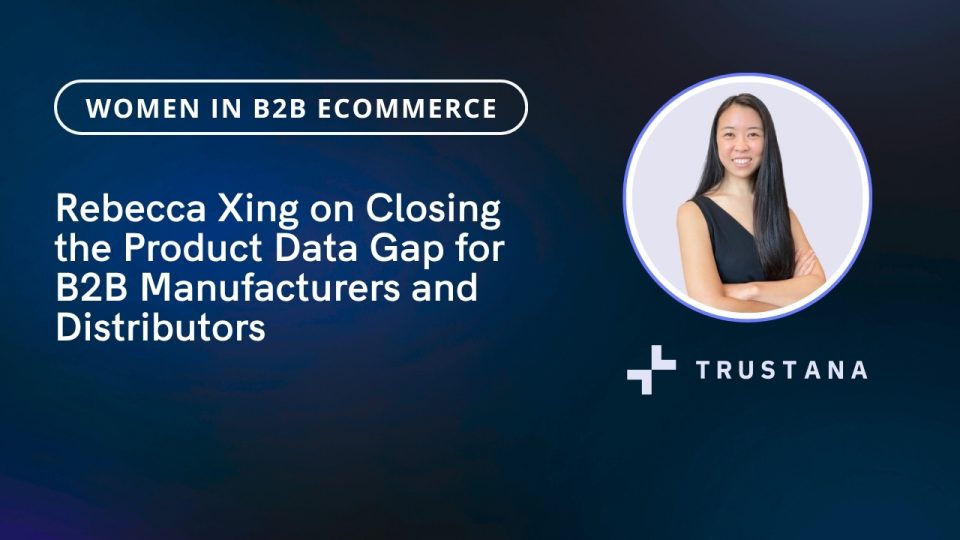
The next phase of B2B eCommerce will be built on better product data. That was the throughline of a recent conversation with Rebecca Xing, CEO of Trustana, the Singapore-based, Temasek-backed AI product data platform recognized as a 2025 Forrester Tech Innovator for Retail. Xing joined the B2BEA Women in B2B eCommerce series to talk about how she got here, what is finally possible for manufacturers and distributors, and where she sees the biggest opportunity for first movers.
Her remit covers a foundational piece of digital transformation. Trustana helps retailers, distributors, and brand owners aggregate, enrich, syndicate, and localize the full product data lifecycle, with a focus on the complex, high-SKU catalogs that define industrial and B2B commerce.
From BCG to Building Product Data Infrastructure
Xing did not start in catalogs. She started in consulting. “I started my career in BCG as a management consultant in San Francisco,” she said. “I worked on digital transformations for all sorts of technology companies, mostly in the telecom, media, and technology sector.”
The pull toward building, rather than recommending, came quickly. “I wanted to build solutions, not just recommend them, so I switched over to building solutions as a product manager in startups,” Xing said. From there, she moved into the supply chain side of commerce, working on warehouse management and supply chain management systems before moving into marketplaces. She has been in eCommerce for more than a decade, and at Trustana for six years.
Her preference for supply chain over flashier consumer software was deliberate. “I liked the idea of building software where something in the physical world was happening as a result,” she said. “As opposed to maybe advertising, which is something that happens purely digitally. When I was working in supply chain and warehouse management systems, things that I was building in the software meant that people were doing stuff, physically, with those boxes.”
B2B software, she added, has a satisfying clarity. “I really liked the ‘does this add value, yes or no,’ straightforwardness of B2B software,” she said. “The B2C side was much more emotional. Maybe you go viral, maybe you don’t.”
Why Product Data is the Bottleneck Nobody Talks About
Trustana itself began as a B2B marketplace, and that origin shaped the company. “In the first two years, we were a B2B marketplace,” Xing said. “We experienced firsthand how terrible the product data situation was.”
For a cross-border marketplace, the problem hit on multiple fronts. “We needed to get that data prepared for sales purposes, for marketing purposes,” she said. “We also needed the data for compliance and customs clearance. We were hit doubly hard, which I think is always the case for every distributor.” That experience pushed the team to invest heavily in technology to solve the catalog problem, and when large language models matured, Trustana pivoted from running a marketplace to selling the product data platform underneath it.
The scale of the problem is bigger than most B2C operators realize. “If you have 10 million SKUs, which, if you’re in the B2B space, is entirely possible, then getting those into a tech platform of some sort, by hand, is crazy,” Xing said. “How many people working manually, for how long, is going to get to 10 million SKUs?” The honest answer, in her telling, is that it was never financially viable before.
Without clean product data, manufacturers and distributors cannot deliver on customer expectations. As Xing’s former boss used to put it, B2B commerce is the “dark matter” of the commerce world. “You can’t see it, but it’s everywhere,” Xing said. “B2B commerce is just massive, way, way bigger than B2C commerce, even though the layperson doesn’t really think about it.”
The First-Mover Window for AI in B2B
Where Xing sees the real opportunity is in the gap between what is now possible and how few operators have moved on it. “There’s a massive opportunity at the moment, where folks who adopt technology sooner rather than later have a first-mover advantage, because things are up in the air,” she said. “There’s the space to be the authority. In LLM conversations, there’s just not a lot of information out there. You could be the go-to when somebody asks ChatGPT, what’s the best part for me to purchase?”
Product data quality matters more in B2B than B2C precisely because the products themselves are more complex. “If you’re selling a piece of clothing, if you don’t have very good product data, it’s not that bad, as long as you have an image,” Xing said. “But that’s super different when you’re talking about a replacement part for your car. The amount of data that you need on that part is much, much longer of a list. If you don’t have that data, it affects your capability to be effective in the rest of your tech stack, including for AI initiatives.” For more on how product data fits into the broader stack, see B2BEA’s product content and digital transformation topic pages.
This is a chance for the industry to leapfrog the work that people have been doing “by hand” in Excel for the past 10 or 20 years. As Xing shared, “Now we’re in a space where this could be cost-effective, and it could be quick. You can start unlocking all this capability that the B2C side has been utilizing, plus all the new stuff coming out that is new to eCommerce entirely.”
How AI is Changing the Work, Internally
Xing said AI has reshaped how Trustana itself operates, with the biggest gains on the engineering and build side. “We do expect all of our engineers to be coding with tools,” she said. “The tools are only getting better and better. Beyond the engineers now, the rest of our build team, including the designers and product managers, are able to do things they weren’t able to do previously. Our design team can create full prototypes or experiment with design systems in a fraction of the time.”
That has changed handoffs across the team. “I can hand over to the engineers something that is in great detail, because the AI has been able to build out what that prototype should look like,” Xing said. Product managers who are not engineers by background “are able to do POCs and experiment with how things would work.” Marketing and go-to-market teams are also using AI to sense-check copy and test campaigns.
Xing was careful not to overstate the shift. “There still is, of course, that last mile delivery part of the build that has to be done by somebody who has the technical knowledge,” she said. “But there’s a lot of stuff, especially on the upfront, early ideation, prototyping stage that really can be done by anyone at this point.”
Advice for Women, and Anyone, Entering B2B eCommerce
Asked what she would tell women, or anyone, building a career in this space, Xing was direct. “Now more than ever, there’s an availability of information about things you can explore that may not have naturally occurred in your life,” she said. “Previously, without so much good information, you would only know what is around you in proximity, what your friends do, what their parents did, what your parents did. Now there are so many resources. The main blocker is more initiative and proactivity in going in and finding it.”
What separates careers in an AI-saturated market, she argued, is taste and work ethic. “If AI will be the great leveler in terms of just knowledge, and even maybe experience, then the thing that differentiates you remains to be your taste and your work ethic,” Xing said. “You can’t run away from that. Everybody has AI, so what are you doing differently?”
On Being a Woman in a Male-Dominated Industry
Xing has spent her career in industries that skew heavily male, and she has chosen to treat that as an opportunity. “I never really let it deter me personally,” she said. Consulting was a male-dominated industry as well, and technology in general is male-dominated. Anything where there’s a bit of a challenge, there’s also a bit of an opportunity.” She pointed to how quickly women in the field find one another. “If I find another woman in B2B eCommerce, they’re excited to get to know you,” she said. “You can have a leg up in terms of building community with others who are like you.
Join the Women in B2B eCommerce Community
B2BEA’s Women in B2B eCommerce program is a growing network of practitioners, vendors, and leaders driving the industry forward. To stay connected, follow the topic page on b2bea.org and join the Women in B2B eCommerce LinkedIn group. Upcoming events include receptions, breakfasts, and dinners alongside major B2BEA gatherings in the United States, the United Kingdom, and Australia in 2026.
For more on Rebecca Xing’s work, visit Trustana, and connect with her on LinkedIn. According to Forrester, Trustana’s recognition as a 2025 Tech Innovator for Retail signals the broader industry’s pivot toward AI-native product data infrastructure, a shift manufacturers and distributors can no longer afford to watch from the sidelines.
Related News & Insights
Sabrina Williams has spent more than two decades at the intersection of marketing and technology, and...
 Insights & advice
Teresa Herrmann manages digital commerce at Bailey International, a Knoxville-based manufacturer and distributor of hydraulic cylinders,...
 Insights & advice
The next wave of careers in B2B eCommerce will look a lot like the last one,…
 Insights & advice
For B2B manufacturers and distributors, the operational difficulty of digital commerce often shows up in product…
 Insights & advice
Article Three of Four — The B2B Ecommerce Association White Paper Series on PIM Innovation Most…
 Insights & advice
Tonia Coletta spent fifteen years in the beer industry before she ever thought seriously about millwork….