

 Podcast
Dechay Watts on Why B2B Loyalty Depends on Operational Trust, Not Perks

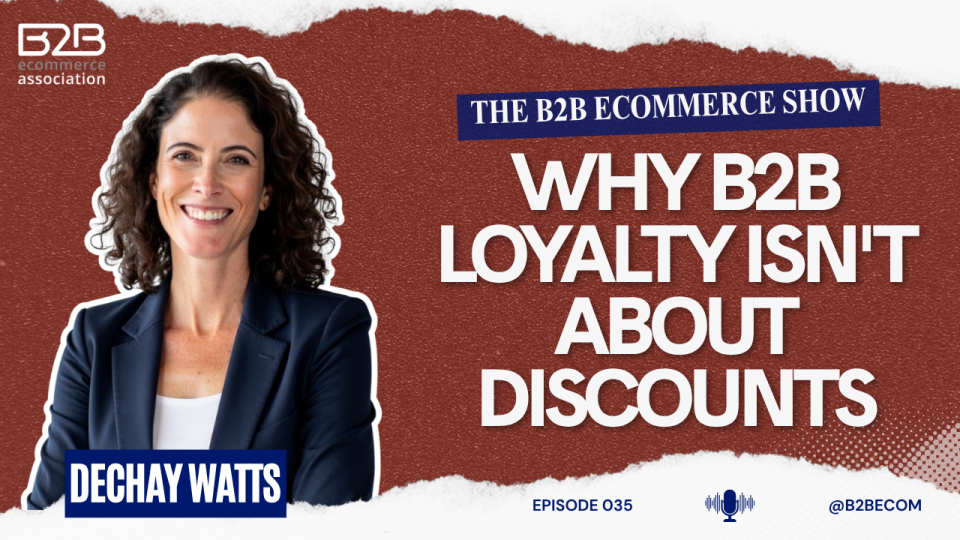
Most manufacturers and distributors still think of loyalty as a rewards program: points, rebates, a discount for hitting a spending threshold. Dechay Watts, VP of Digital Marketing Services at Smith Commerce, argues that framing misses what actually keeps B2B customers coming back. In a recent conversation on the B2B eCommerce Show, Dechay and host Justin King unpacked why loyalty in B2B looks less like a punch card and more like an operating system built around a customer’s job.
Dechay has spent more than two decades helping B2B, SaaS, and enterprise brands turn complex ideas into growth, first in PR and SEO, then as co-founder of the content marketing agency SPROUT Content before its acquisition by WPP. That background in data-driven content strategy shapes how she thinks about loyalty today, less as a marketing tactic and more as a business strategy that touches sales, IT, and customer service alike.
A Different Kind of Loyalty
The B2C playbook for loyalty runs on perks, discounts, and points designed to bring someone back. Dechay explained that B2B works differently. The goal isn’t repeat purchases for their own sake. It’s removing friction from the buyer’s day-to-day operations so the relationship holds on its own.
That distinction matters because B2B and B2C buying behave in fundamentally different ways, and a rewards mechanic built for one rarely translates to the other. Dechay pointed to procurement teams as an example. Their success is measured by efficiency, cost control, and operational continuity, so their loyalty tracks directly to how well a supplier helps them perform day to day. A supplier that reduces friction, even in small ways, earns more repeat business than one offering a percent-off coupon.
Bosch’s Home Comfort Group offers a real-world version of this idea. Rather than building a discount program, the company built a unified loyalty portal spanning 50 brand-country combinations and more than 22,000 products, giving partners a single, dependable place to work. The loyalty came from the reliability of the system itself, not from a rewards tier.
What the Data Tools Are Actually For
Much of the conversation centered on customer data platforms, or CDPs, and how B2B organizations often buy the technology without a clear plan for using it. Justin asked Dechay to define the term for listeners unfamiliar with it. Gartner describes a CDP as software that unifies a company’s customer data from marketing and other channels into a single, usable profile, a definition Gartner has continued to refine as the CDP market matures. Dechay described the practical difference from a CRM this way: a CDP unifies information from every touchpoint into one profile, while a CRM typically does not have that same unifying capacity.
The bigger issue, in her experience, is not whether a company owns a CDP. It’s whether anyone activates it. Enterprise teams often invest heavily in the platform itself, then leave marketing and sales out of the conversation about what to do with the data once it is centralized. B2BEA’s own guidance on customer adoption in B2B makes a related point: the tools only create value once customers, and the internal teams supporting them, actually use them.
Personalization Is Not the Same as Segmentation
Dechay drew a clear line between the two. Segmentation groups customers by shared attributes, then messages to the group. Personalization uses the specific data available about an individual account, tied to what that account has actually done, to shape the next interaction, rather than relying on a generic persona built years earlier and never revisited.
The research backs up why this matters. McKinsey’s Global B2B Pulse survey found that companies using direct one-to-one personalization were far more likely to grow market share than those that did not. A more recent edition of the same survey found the gap widening further: market leaders are now four times more likely than laggards to deploy true one-to-one personalization. Fragmented data is usually the reason companies fall short, leaving them unable to act on the knowledge already sitting inside the business.
Product data plays a role here too. ASSA ABLOY’s move to consolidate product information across more than 150 countries, detailed in a recent B2BEA case study, shows how a single source of truth for product data becomes the foundation for the kind of personalization Dechay described.
Where AI Agents Fit In
Justin pushed the conversation toward automation, asking whether AI agents could handle the pattern recognition that loyalty programs depend on: knowing when a customer’s equipment needs maintenance, when a part is due for reorder, when a service window is coming up. Dechay agreed this is squarely where AI adds value, suggesting agents could recommend reorders based on usage patterns or align recommendations to real-time inventory, prompting a reorder before the customer has to think about it.
Justin connected this to a broader shift he has been encouraging listeners to try directly.
His own reference point is a phrase he coined in 2008: B2B is all about helping a customer do their job. The wider market data suggests this shift is already underway. A recent McKinsey Pulse survey found that companies growing market share fastest were more than twice as likely to have implemented generative AI in their buying and selling processes compared with their peers, and personalization was one of the clearest dividing lines between leaders and laggards.
Personalizing for a Committee, Not a Person
B2B purchases rarely come down to one buyer. A single account might involve someone in procurement, someone using the product day to day, and someone approving the budget, each with different needs. Dechay’s answer to personalizing across a buying committee was to zoom out from the individual and focus on the role. The account, the contract, and the moment in time matter more than any one person’s preferences, since that person can leave the role while the account remains.
She also pointed to something practical: getting people from IT, marketing, sales, and the business side in a room together to walk through the customer journey as a whole, rather than each team optimizing its own channel in isolation. The gaps between departments, she noted, are often where the real personalization opportunities get lost.
The Myth Worth Retiring
Asked to name the biggest myth in B2B loyalty programs today, Dechay didn’t hesitate.
Her point throughout the conversation was consistent: loyalty is not a campaign that marketing runs on the side. It is built into how easy, or how difficult, a company makes it for a customer to do their job every single day.
About the Guest
Dechay Watts is VP of Digital Marketing Services at Smith Commerce, where she leads cross-functional teams spanning paid media, SEO, web experience, analytics, and content for B2B, SaaS, and enterprise brands. She previously co-founded SPROUT Content, a national content marketing agency later acquired by WPP, and has spent more than 20 years helping organizations turn complex ideas into measurable growth.
About the Host
Justin King is the founder of the B2B eCommerce Association and host of The B2B eCommerce Show. He built Salsify’s B2B practice, founded B2X Partners, and grew Oracle Commerce B2B from 3 percent to more than 55 percent of sales, and now works with manufacturers and distributors on digital transformation and customer adoption strategy.

Related News & Insights
 Podcast
Most manufacturers and distributors already know they need to do something about artificial intelligence. Few know…
 Podcast
Every January, a handful of reports try to tell manufacturers and distributors where B2B eCommerce is…
 Insights & advice
MillerKnoll has been doing B2B eCommerce for more than twenty-five years. That tenure, spanning multiple platform generations,…
 Insights & advice
Article Three of Four — The B2B Ecommerce Association White Paper Series on PIM Innovation Most…
 Podcast
For most of B2B, eCommerce adoption has followed a predictable arc: early skepticism, gradual experimentation, and…
 Insights & advice
Brooke Logan did not set out to work in B2B eCommerce. Her degree is in biology….