

 Insights & advice
Jessica Wetzel on Two Decades Connecting B2B Buyers and Suppliers

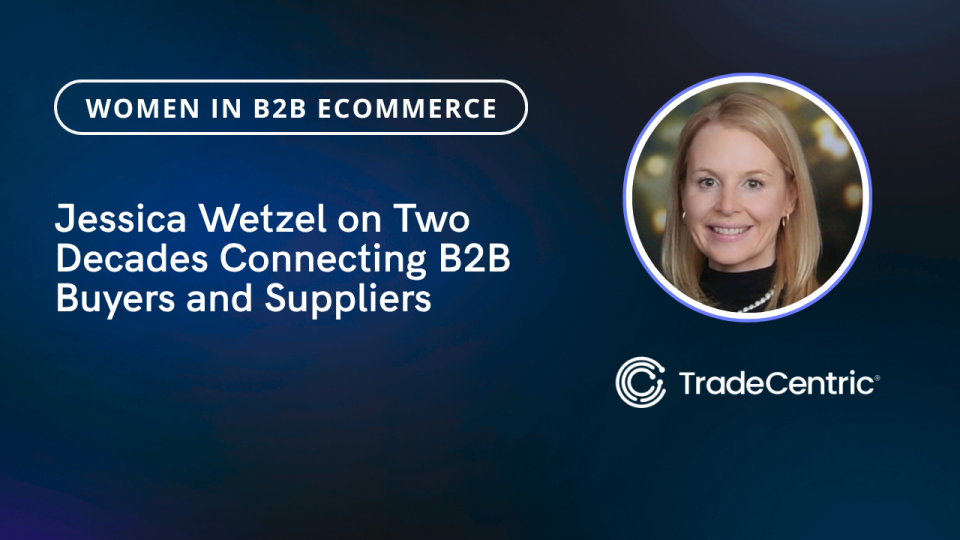
The next wave of careers in B2B eCommerce will look a lot like the last one, built role by role, often by people willing to be first. That was the thread running through a recent conversation with Jessica Wetzel, Director of Product Management at TradeCentric, the B2B integration platform that connects supplier eCommerce sites to buyer eProcurement systems through PunchOut Catalogs, Purchase Order automation, and Invoicing. Wetzel joined the B2BEA Women in B2B eCommerce series to talk about her path from inside sales to product leadership, what is finally changing for B2B buyers and suppliers in the age of AI, and why she thinks B2B is one of the most rewarding places for a curious operator to build a career.
Her remit at TradeCentric covers the connective tissue of B2B commerce. The company sits between supplier eCommerce platforms and the enterprise procurement systems buyers use to authorize, place, and reconcile orders, the systems that often determine whether a digital channel can actually serve a large customer at all.
A Career Built on First-of-Its-Kind Roles
Wetzel did not set out to work in B2B. “When I graduated high school in 1999, B2B wasn’t even on my radar. I’d drive past industrial parks and think nothing of them.” Two decades later, she has spent her entire career in the space, and her path runs through roles that did not exist before she took them.
She started in B2B distribution in 2004, spending the first five years of her career in inside sales before moving into a brand-new eCommerce administrator role her employer created for her in 2009. “There was no blueprint – I drew it as I went,” she said. “Every platform you bought was catered for B2C. There were no B2B modules, no out-of-the-box capabilities. B2B eCommerce Platforms simply did not exist.”
The deeper challenge revealed itself through customer interviews. Wetzel was driving significant traffic to the eCommerce site, but orders weren’t following. “Buyers were shopping online but they couldn’t place the order,” she said. “They had to enter their requisitions into a procurement system. We were getting orders by email and fax and those channels were outpacing eCommerce, even though the shopping was happening digitally.”
The gap between browsing and buying was a structural one: the supplier’s eCommerce platform and the buyer’s procurement system weren’t speaking to each other. Wetzel conducted a vendor search and in 2012 became the fifth customer of a company called PunchOut2Go – now known as TradeCentric, where she works today. She built the integration program from that single connection to hundreds over several years, and watched it become the fastest-growing order channel in the business. The through line of her career – connecting buyers and suppliers – had found its most literal expression.
The pattern repeated when she joined TradeCentric in May 2020. “It was COVID, and there was this surge for automation in supply chains,” Wetzel said. “The company needed a formal product management department. So they brought me in as the very first product manager.”
Wetzel built TradeCentric’s connector program, leading the launch of PunchOut, Order, and Invoice automation for NetSuite ERP and rebuilding the company’s Salesforce connector. Eventually, she took on full responsibility for analytics and the user experience, launching TradeCentric Analytics in October 2024 to give customers a clear view into what’s happening across their integration program.
Today she leads product management for the company and is deep in discovery work on artificial intelligence and how it pertains to eProcurement systems and purchasing.
The Through Line: Connecting Buyers and Suppliers
Looking back, Wetzel identified a clear pattern. “I spent the first five years of my career in inside sales just talking with buyers and understanding what they needed, and trying to understand these complicated B2B procurement processes,” she said. “I had to learn what was important to procurement teams and leadership.” That groundwork, she said, became the spine of everything that came next. “Connecting buyers and suppliers to each other ended up being the through line of the rest of my career.”
That pattern is also the story of B2B eCommerce more broadly. Wetzel pointed to the persistence of fundamental questions across two decades. “I went to a conference recently and they were talking about proving the ROI on the digital channel,” she said. “I’ve been in that conversation since 2009. What we’re doing is helping the market understand how to measure and articulate the value of what they’ve built.”
Why B2B is Worth Building a Career In
Wetzel makes a case for B2B that has little to do with hype. “It’s such a ripe industry for innovation, and it’s really fascinating,” she said. “One day I’ll talk to a coal mining equipment manufacturer, then it’ll be another company that provides products for interior designers or hospitals.” She compared it to the Mr. Rogers episodes about how crayons get made. “You never think about how the sausage was made. It’s so fascinating.”
The work also comes with a rhythm that B2C rarely offers. “B2B buyers aren’t browsing, they are working, and they need to get it done efficiently. That kind of purposeful buying creates a different rhythm than consumer commerce.” Wetzel said. “The buying cycles are defined, the customer relationships are long-term, and that creates a kind of sustainability – professionally and personally – that you don’t always find on the consumer side.” She noted that while B2B teams work hard, the predictability of the calendar is something she has come to value. “My sister’s been in B2C her whole career. Between Black Friday and Christmas, she cannot get off for the holidays. In B2B, that predictability exists. We still put in the work, but we can actually plan our lives around it.”
Where AI Earns Its Place in B2B
Wetzel is currently leading product discovery on AI across the buyer and supplier landscape, interviewing buyers and suppliers in parallel to “cut through the hype and find where AI really creates value for people” – a signal of where TradeCentric is evolving its platform to help B2B suppliers prepare for an agentic commerce future. The picture emerging from those conversations is more grounded than the one in market headlines. “B2B buyers have to be really sharp, meticulous, and accountable for every dollar they spend,” she said. “But in reality, a lot of the people placing orders aren’t procurement professionals; they’re location managers, technicians, administrators. The near-term AI opportunity is to follow them through the process like a knowledgeable colleague over their shoulder, helping them act like a certified procurement professional would.”
Wetzel is clear-eyed that AI’s role in procurement will expand over time, including eventually how buyers discover and evaluate products. But her early research points to something more immediate and perhaps more consequential: the governance layer. “And when that evolution happens,” she said, “the AI is going to need trusted, accurate supplier data, pricing, inventory, and product specs. What’s interesting is that in our research, neither buyers nor suppliers want the other side owning that connection. They both point to the same answer: a trusted neutral intermediary.”
Advice for Women, and Anyone, Entering B2B eCommerce
When asked what she would tell someone considering getting into B2B eCommerce, Wetzel didn’t hesitate. “Do it now. Don’t think twice.” The opportunity, she argues, is hiding in plain sight. “B2B doesn’t get the headlines consumer products do, but it runs hospitals and cures diseases. It stocks vet clinics, helps people build homes, and lays the infrastructure that gets kids to school and keeps fire trucks on the road. If you want to solve real problems and innovate, this is where you do it. The work has stakes that most industries can’t touch, and most people have no idea.”
She also urged candidates to give themselves permission to build the role they want. “Make your own role,” Wetzel said. “There are a lot of stories like ours where people make their own roles in B2B, blazing their own trail. I went from a team of one to leading teams, and that opportunity still exists. There’s so much opportunity. Go for it.” When asked how she had learned each new job along the way, she laughed. “Most of the time, I did not know. I just had to learn how to do it. I didn’t know how to write HTML when I became an eCommerce administrator. I learned it. I watched YouTube videos. I didn’t know how to use an email marketing platform. You just do it, and then tweak it and optimize it as you go.”
“There are so many different pieces in B2B that you can find the one that matches,” Wetzel says. “A home for your personality is in there.”
“The ones who will succeed in the new era are those who have an integration infrastructure in place to build on AI capabilities,” Wetzel said. Two decades of connecting buyers and suppliers through inside sales, eCommerce, PunchOut, and now AI discovery have all been pointing to that pattern. For Wetzel, it is not an observation. It is the whole job.
Join the Women in B2B eCommerce Community
B2BEA’s Women in B2B eCommerce program is a growing network of practitioners, vendors, and leaders driving the industry forward. To stay connected, follow the topic page on b2bea.org and join the Women in B2B eCommerce LinkedIn group. Upcoming events include receptions, breakfasts, and dinners alongside major B2BEA gatherings in the United States, the United Kingdom, and Australia in 2026.
For more on Jessica Wetzel’s work, visit TradeCentric, and connect with her on LinkedIn.
Related News & Insights
 Podcast
Adrienne Hartman has spent 26 years turning technical instinct into business judgment, and 19 of those…
 Podcast
The founder and CEO of Luminos Labs has spent 16 years watching digital commerce projects stall…
Sabrina Williams has spent more than two decades at the intersection of marketing and technology, and...
 Insights & advice
For manufacturers and distributors managing large, complex product catalogs, the gap between the data that exists…
 Insights & advice
By Troy Sample, Vice President of Sales, and Dan Bronson, Partner, Digital Strategy and SEO, impaqX…
 Insights & advice
For nearly two decades, Nichole Hess has been quietly building the layer that everything in B2B eCommerce sits…