

 Podcast
Why B2B eCommerce Success Starts With Executive Alignment, Not Technology

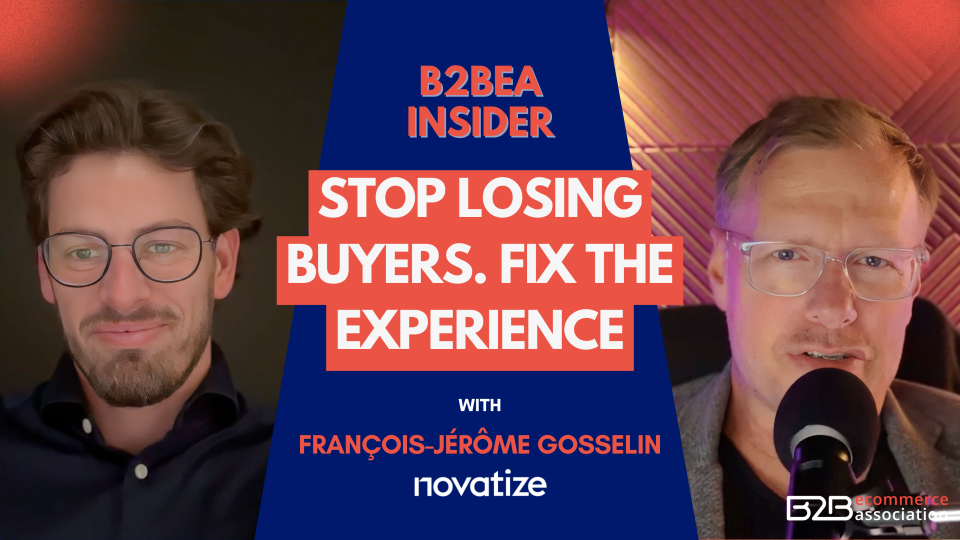
Novatize CEO François Gosselin on unified commerce, customer adoption, and the organizational change that technology alone cannot fix.
In a recent episode of The B2B eCommerce Show, host Justin King sat down with François Gosselin, CEO and co-founder of Novatize, the Quebec-based commerce firm that was named B2B eCommerce Agency of the Year at the Americas B2B eCommerce Industry Awards. The conversation covered a range of issues that manufacturers and distributors face when modernizing their commerce operations, from the organizational dynamics that stall digital projects to the technology decisions that can make or break a buyer’s experience.
What emerged from the discussion was a clear message: the most important decisions in B2B eCommerce are rarely about which platform to choose. They are about whether the people inside an organization are working toward the same goal.
François Gosselin, CEO of Novatize, on The B2B eCommerce Show with Justin King.
The Conversation No One Wants to Have
Gosselin opened the discussion by reflecting on conversations he had at a recent industry conference. The sessions that resonated most, he noted, were not the ones centered on platforms and integrations. They were the ones about strategy, internal alignment, and why digital initiatives stall before they gain traction.
“In B2B, we look at different KPIs, the most important one being often customer adoption rate. And that says a lot because if you don’t have alignment between all your locations as a B2B company, if you don’t have alignment on different incentives as part of your leadership team, and that everything under this follows through, you’re not going to be able to deliver that seamless experience.” – François Gosselin, CEO, Novatize
King agreed, noting that executive alignment and customer adoption are widely recognized as the real blockers in B2B digital transformation, but they are treated as unsolvable problems. “People kind of put those in a bucket that are like unachievable,” he said. “They move on to the things that are easier to solve. Technical things are just easier to solve than people problems.”
The industry is beginning to gather the case studies and frameworks needed to address those people problems directly. Gosselin’s point is that the technology conversation should follow the strategy conversation, not lead it. For manufacturers and distributors dealing with multiple locations, independent profit-and-loss units, and competing internal incentives, that sequencing matters enormously. You can read more about how B2B companies are navigating digital priorities under pressure in the B2BEA’s coverage of the sector’s broader trajectory.
90% of B2B buyers are ready to switch suppliers if they do not receive a good online buying experience, according to data cited by Gosselin. The business case for investing in seamless customer journeys has never been stronger.
What Unified Commerce Actually Means
The word “omnichannel” has been in circulation for years. Unified commerce is its operational successor, and Gosselin offered a grounded definition. The concept originated in Asian retail and has since extended into B2B distribution. At its core, it means that a buyer can start a purchase on one device, at one location, and complete it somewhere else, drawing from the entire organizational catalog without friction.
“If we’re imagining a tooling distributor, as a client I want to be able to start my buying process on my phone. I want to be able to pick up my drill and my helmet at the nearest location. It sounds easy, but it means you have the incentives in place at a strategy level. And then as the technology, you have a good OMS with the rules set up so you can get your inventory moved very quickly and accurately between locations.” – François Gosselin, CEO, Novatize
Gosselin was direct about the organizational complexity underneath that seemingly simple scenario. Store managers need to be willing to move inventory away from their own locations. Incentive structures need to reward that behavior. Catalogs need to be unified. None of that is a technology problem in the first instance. You can explore Novatize’s unified commerce practice to see how they approach this with clients in manufacturing and distribution.
The payoff for getting it right is significant. Gosselin cited data showing that companies with a successful unified commerce transformation see, on average, a 14 to 15 percent increase in revenue from digital channels. For mid-market and enterprise-grade distributors and manufacturers, that is a meaningful gain.
Customer Adoption Is Not the Same as Customer Acquisition
One of the sharper distinctions in the conversation was the difference between how B2C agencies and B2B specialists define success. King framed it as a funnel problem. In B2C, the funnel starts with a stranger and ends with a customer. In B2B, the funnel starts with a customer, often one who has spent years and millions of dollars with a supplier, and the goal is to deepen that relationship digitally.
That distinction has direct implications for how agencies should be structured and how practitioners should evaluate their partners. Gosselin described B2B agency work as requiring more backend engineers, more business analysts, and a fundamentally different mindset around the cost of losing a buyer versus the cost of acquiring one.
“Losing a buyer is way more costly than acquiring a new client, either in B2C or B2B. And in B2B, it’s just exponential. So you don’t want to lose that buyer. So you do have to invest a lot to have a seamless experience.” – François Gosselin, CEO, Novatize
King built on this with a practical observation about the people on both sides of that equation: “The skills of people and the technical knowledge you need is different for those two groups.” He added that agencies could technically serve both B2B and B2C five years ago, but the increasing specialization of the market has made that harder to do well. For more on how buyer expectations are shifting in B2B, the B2BEA has tracked the demands of B2B buyers in 2024 and beyond.
SPINE: Reducing Time-to-Market for Complex B2B Operations
The conversation turned to SPINE, Novatize’s proprietary accelerator for Shopify-based B2B implementations. Gosselin explained that years of working with complex B2B clients, including distributors managing multiple locations, catalogs from different suppliers, and intricate approval workflows, revealed consistent patterns. SPINE packages those patterns into a foundation that shortens implementation timelines from 18 months to as few as four to six months.
One concrete example he offered was a school supplies company whose teachers needed to submit purchase requests for approval before a transaction could be completed. Out-of-the-box Shopify does not handle that workflow natively. SPINE adds the approval flow logic, inventory visibility by location, and lead-time management by product, all without building from scratch on each engagement.
“SPINE is just really the result of years of working with complex B2B challenges and bundling those together to be able to offer a faster time to market to B2B companies.”- François Gosselin, CEO, Novatize
Gosselin also articulated Novatize’s broader philosophy on customization: begin with what is available out of the box, adopt market best practices where possible, and reserve custom development for the processes that are genuinely unique to a business model. “There’s something out there that will do 80 percent of the work,” he said, “and then you can focus on the 20 percent that’s left.” You can learn more about SPINE and how it addresses complex B2B needs on Shopify.
How to Choose the Right Commerce Partner
Gosselin offered practical guidance for manufacturers and distributors evaluating agencies. His advice goes beyond asking for case studies or references. He recommended asking any candidate agency to explain, in their own words, what they understand to be the business problem and what they would measure at launch and at 90 days post-launch.
“If what you want is to retain your customers because your customers are complaining about the experience,” he said, “and the agency tells you that they’re going to run ads or do email marketing campaigns to do lead nurturing, maybe that’s not your core focus.” The mismatch between what a client needs and what an agency defaults to is one of the most common and costly mistakes in B2B eCommerce implementations.
He also recommended asking agencies to produce visual representations of how processes, operations, and technology will work together. “This will validate their understanding of your project,” he said. Practitioners looking to build that same internal knowledge base can explore the B2BEA’s analysis of the top trends driving digital sales in B2B, which outlines many of the strategic questions a strong agency partner should be able to answer.
The Long Arc of Digital Transformation
King drew a memorable analogy near the end of the conversation. Chick-fil-A, the American fast food chain, took seven years to roll out its signature phrase “my pleasure” across all of its locations. Two words. Seven years. The lesson was not about bureaucracy. It was about what it actually takes to change behavior at scale across a distributed organization.
B2B eCommerce transformations follow a similar arc. The technology can be deployed in months. The behavioral and organizational change that makes that technology valuable takes years. Gosselin acknowledged this directly, describing digital transformation as a long roadmap that demands everyone on board, but one that is achievable when leadership aligns around a shared vision of what the customer experience should look like.
For manufacturers and distributors at the beginning of that roadmap, Gosselin’s message was straightforward: start with the experience you want to deliver to your customers, make it concrete and visible to your leadership team, and work backward from there to the strategy and technology that will support it. The tools, he noted, have never been better. The bigger challenge, as it has always been, is the people.
Hear more conversations like this one on The B2B eCommerce Show. Browse All Episodes
About the Guest: François Gosselin is the CEO and co-founder of Novatize, a professional commerce firm specializing in B2B eCommerce for manufacturers and distributors. Novatize was named B2B eCommerce Agency of the Year at the 2025 Americas B2B eCommerce Industry Awards.
About the Host: Justin King is Global Managing Director of the B2B eCommerce Association and host of The B2B eCommerce Show. He has been writing and speaking about B2B eCommerce since 2007.

Related News & Insights
 Podcast
Most manufacturers and distributors already know they need to do something about artificial intelligence. Few know…
 Podcast
Every B2B manufacturer and distributor hears the same pitch when a new commerce platform comes calling:…
 Podcast
Every January, a handful of reports try to tell manufacturers and distributors where B2B eCommerce is…

Replatforming is rarely just a technology project. It is an operational transformation initiative that touches pricing…

Selecting a B2B eCommerce platform isn’t just an IT project, it’s a decision that touches revenue,…
 Podcast
In B2B commerce, we often focus on building the perfect storefront, clean UX, robust search, optimized…